

The Science of Entombment: What Happens to a Body Buried in a Mausoleum
When a casket is placed inside an above-ground crypt, the body enters a completely different microclimate compared to an in-ground grave. In standard earthen burials, the surrounding soil delivers moisture, burrowing insects, and a massive ecosystem of active microbes that accelerate flesh breakdown.
Above ground, the crypt acts as an environmental barrier. It isolates the casket from earth, groundwater, and exterior weather fluctuations. Because the crypt is enclosed, oxygen levels drop relatively quickly as aerobic bacteria consume the initial air supply. Once that oxygen is depleted, standard aerobic decay slows down dramatically.
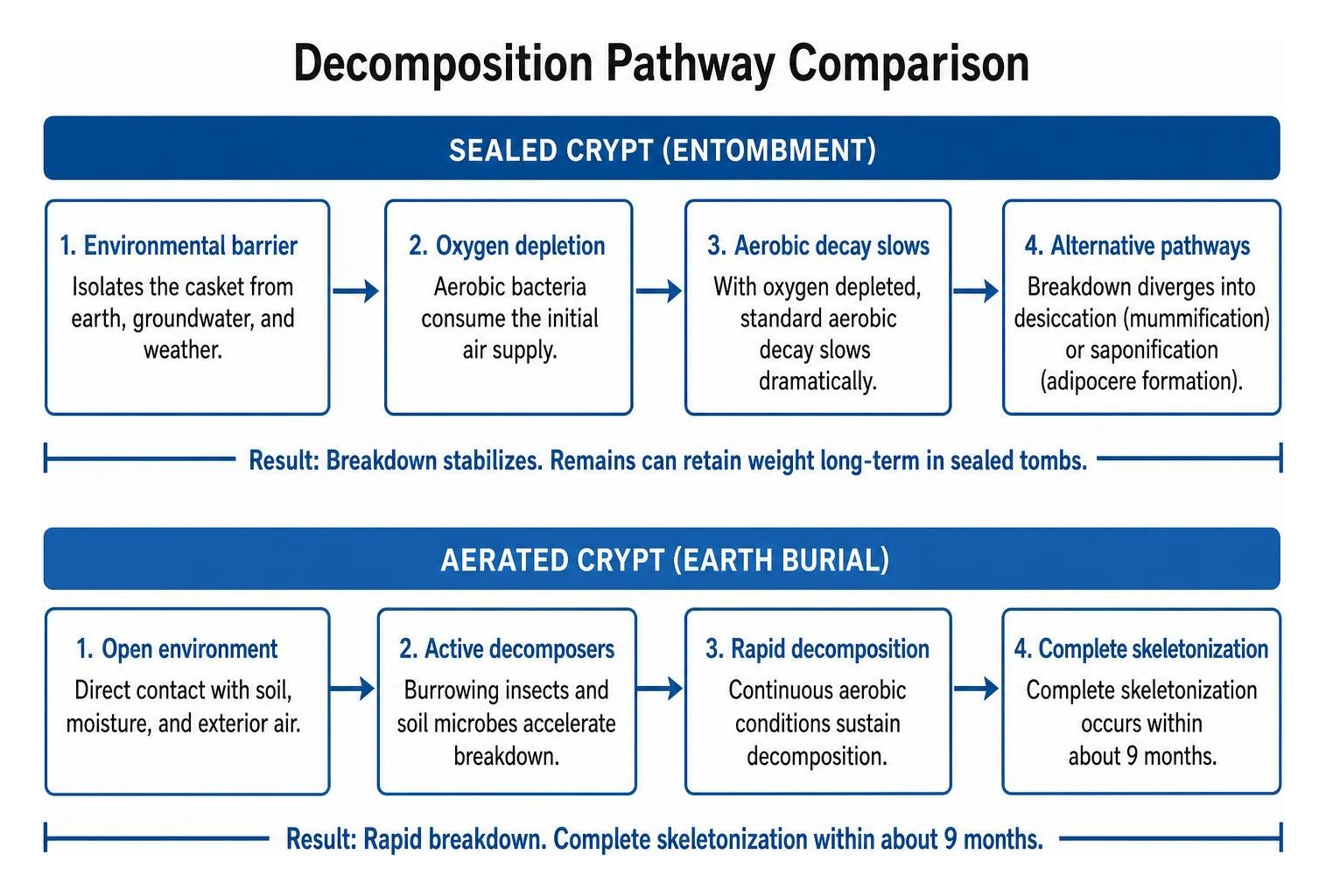
A landmark taphonomical study on decomposition in ordinary vs aerated tombs demonstrated how dramatically the crypt environment alters natural breakdown. Researchers found that samples buried directly in the earth underwent complete skeletonization within just 9 months. In contrast, remains placed inside traditional sealed tombs retained about 47% to 48% of their initial weight even after 18 to 24 months. The physical breakdown essentially hits a stabilization plateau because the moisture cannot readily escape and soil-borne decomposers cannot enter.
Desiccation, Saponification, and Adipocere Formation
Without soil organisms, what takes place instead? The biological fate inside a crypt typically diverges down one of two paths: desiccation (mummification) or saponification (grave wax formation).
- Desiccation and Spontaneous Mummification: In crypts with adequate passive airflow or dry ambient air, the body’s natural fluids slowly evaporate into the surrounding chamber. As moisture levels drop, bacteria can no longer thrive. The skin and underlying tissues dry out, shrink, and harden into a durable, leathery state. This natural mummification process can preserve physical features for decades.
- Saponification and Adipocere Formation: If a crypt remains humid and completely anaerobic (oxygen-deprived), moisture stays trapped within the casket. Under these damp, airless conditions, anaerobic bacteria facilitate the hydrolysis and hydrogenation of adipose (fatty) tissue. This chemical reaction converts body fat into adipocere—a firm, grayish-white, waxy substance often called grave wax. Adipocere acts as a natural preservative coating over soft tissues, holding the body’s general contours in place for years or even centuries.
As detailed in a scientific analysis of body preservation in crypt environments, whether a body forms grave wax or naturally mummifies comes down to the delicate balance of humidity and air exchange within that specific burial vault.
Biological Stages: What Happens to a Body Buried in a Mausoleum Over Time
Decomposition immediately following death begins with autolysis, or self-digestion, where cellular enzymes break down internal tissues. In an above-ground setting, this early stage progresses normally, but subsequent putrefaction is severely constrained.
Microbial communities inside tombs behave differently than those in topsoil. As researchers noted in a study on how microbiome shifts driven by temperature and moisture in tombs influence long-term preservation, bacterial colonies inside historical stone chambers are heavily shaped by microclimate stability. Dominant environmental bacteria such as Proteobacteria and Actinobacteria operate under strict moisture thresholds.
When high humidity and warmth persist, anaerobic strains like Clostridium take over, fostering adipocere. When humidity drops, microbial metabolism stalls entirely. Because the aggressive flesh-eating insects and fungi present in soil are absent, the rapid transformation into a skeleton that happens underground within 9 to 12 months simply does not happen here.
The Entombment Timeline: Decades Above Ground
Because above-ground preservation pathways move at a measured pace, physical changes inside a crypt unfold over decades rather than months.
Long-Term Preservation: What Happens to a Body Buried in a Mausoleum After 10 to 50 Years
- Year 1 to Year 2: Initial cellular breakdown occurs, fluids pool and either evaporate or collect at the crypt base, and weight loss stabilizes around 50%.
- 10 to 15 Years: In a well-ventilated, sealed crypt, soft tissues have largely desiccated or transformed into stable adipocere. The remains consist predominantly of skeletal structures, teeth, hair, and preserved clothing fibers, though recognizable mummified tissue may still cling to the bone framework.
- 20 to 25 Years: Any remaining soft tissue has fully dried or converted into a thin, inert residue. Clothing made of synthetic materials or treated wool remains intact, while delicate natural fabrics like silk or untreated cotton begin to degrade.
- 50 Years and Beyond: By the half-century mark, bone collagen begins a slow weakening process, causing bones to become increasingly brittle and porous. Even after 40 to 50 years, entombed individuals in traditional tombs often remain only partially skeletonized compared to in-ground burials that completely skeletonize in less than a year.
Environmental Factors Influencing Decomposition Rates
Several mechanical and physical variables dictate exactly where an individual falls on this timeline:
- Casket Construction: Heavy-gauge metal caskets with airtight rubber gaskets trap every drop of moisture and gas inside. Wooden or non-gasketed caskets allow slow vapor diffusion, which speeds up desiccation and encourages mummification over liquefaction.
- Arterial Embalming: Embalming fluids use formaldehyde-based chemicals to cross-link cellular proteins. This makes tissues temporarily inedible to bacteria, delaying autolysis and giving the body a wider window to dry out before putrefaction can take hold.
- Crypt Ventilation & Drainage: Modern crypts are built with slight forward-to-rear floor slopes and drainage trays to funnel stray fluids away from the casket, alongside dedicated air channels that prevent moisture buildup.
- Local Climate & Thermal Shifts: Indoor, climate-controlled mausoleums offer rock-solid temperature stability, keeping bacterial growth low. Outdoor garden crypts experience seasonal heat cycles that can temporarily spur bacterial activity during peak summer months.
Engineering the Crypt: Why Modern Mausoleums Don’t Smell
One of the most common questions visitors ask is: If bodies are slowly dehydrating inside these stone walls, why doesn’t a mausoleum smell like decay?
The answer lies in specialized structural engineering. Modern community and private mausoleums are not simple concrete boxes; they are sophisticated ventilation and containment networks.
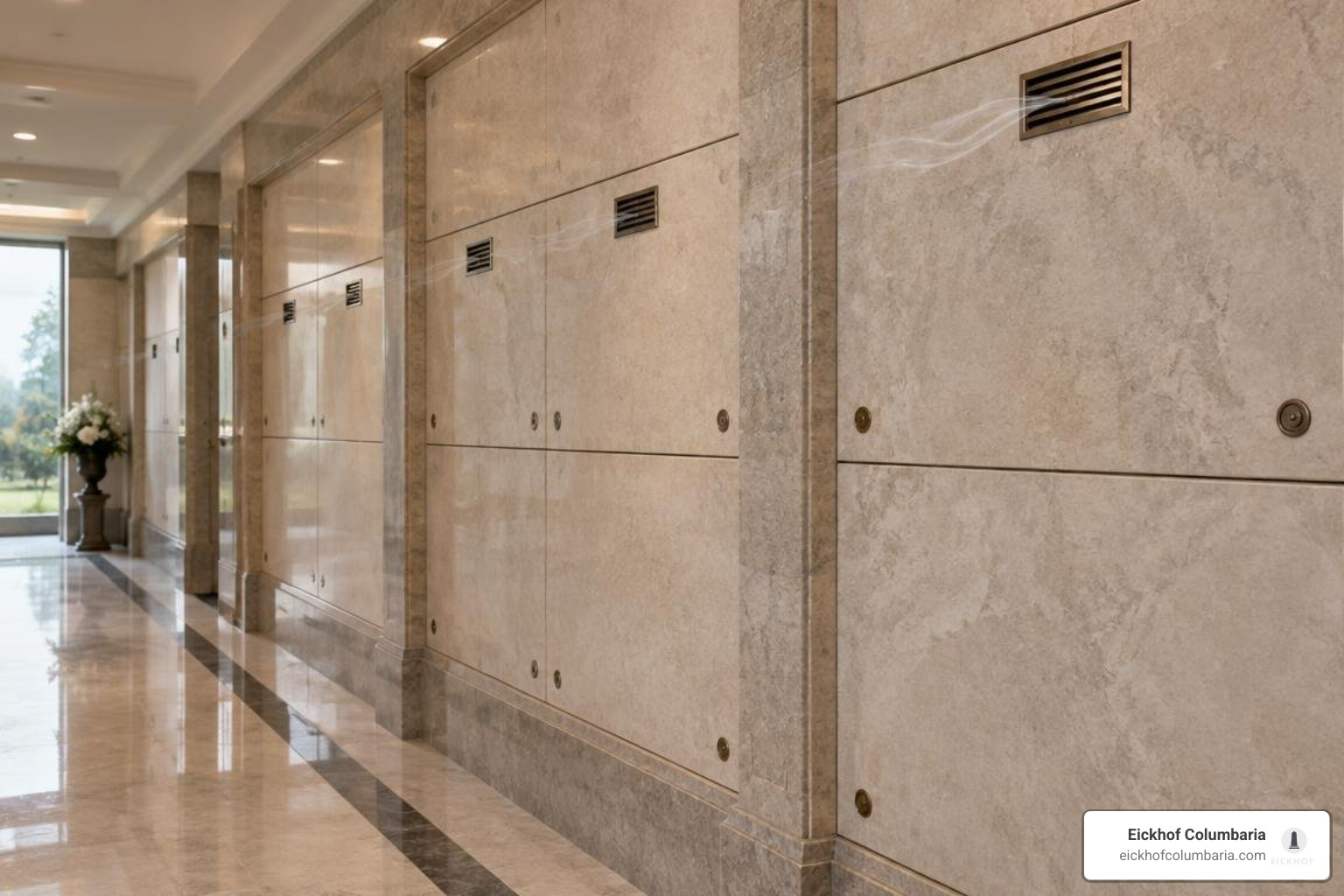
According to a review of engineering principles behind mausoleum odor control, facilities use active and passive air-handling mechanisms to isolate crypt air completely from visitor hallways:
- Dedicated Crypt Venting: Every crypt chamber connects to an isolated internal flue system that vents decomposition gases out through roof stacks, well away from pedestrian areas.
- Activated Charcoal Filtration: Exhaust flues incorporate heavy-duty charcoal filters that neutralize volatile organic compounds (VOCs) and sulfur-based odor molecules before venting air outside.
- Double-Seal Systems: Once a casket is entombed, the crypt opening is sealed with a heavy inner concrete or poly shutter board bonded with industrial caulking. The decorative granite or marble front is then mounted over this primary barrier, creating a dual-layer airtight seal.
- Positive Pressure Airflow: Indoor mausoleum corridors often maintain positive HVAC air pressure, which naturally pushes fresh air into structural seams rather than allowing crypt air to seep out into public lobbies.
Crypt Types and Architectural Configurations
Above-ground entombment facilities offer a variety of crypt layouts tailored to family needs and architectural styles:
- Single Crypts: Individual chambers designed for a single casket, placed horizontally.
- Side-by-Side (Companion) Crypts: Two adjacent horizontal spaces sharing a unified memorial face.
- Couch Crypts: Caskets are positioned lengthwise (parallel to the corridor wall) rather than head-in, creating a wide, elegant marble profile.
- Private Walk-In Mausoleums: Free-standing, custom-built stone buildings housing multiple family crypts, often combined with stained glass and interior seating.
- Community Garden Crypts: Outdoor concrete and granite crypt complexes open to the elements, providing above-ground entombment in an open-air park setting.
For families and cemeteries exploring above-ground alternatives for cremated remains rather than full-body caskets, exploring columbarium structures and purposes provides a helpful overview of how vertical memorial niche walls function.
Mausoleum Entombment vs. Traditional In-Ground Burial
Deciding between above-ground entombment and traditional ground burial involves weighing biological preservation, personal comfort, long-term aesthetics, and cost.
| Feature | Mausoleum Crypt Entombment | Traditional In-Ground Burial |
|---|---|---|
| Primary Decomposition Mode | Slow desiccation (mummification) or adipocere | Rapid putrefaction and skeletonization |
| Time to Skeletonization | Decades to nearly a century | 9 to 24 months (in standard soil) |
| Environmental Exposure | Completely shielded from soil, mud, and groundwater | Enclosed in outer burial vault; subject to subterranean moisture |
| Visitation Comfort | Clean, climate-controlled, dry indoor or covered setting | Outdoor plot; subject to rain, snow, heat, and muddy grass |
| Land Use Efficiency | High (vertical stacking saves significant ground acreage) | Low (requires substantial surface footprint per grave) |
| Maintenance Demands | Structural stone and roof upkeep; no mowing or re-sodding | Continuous lawn mowing, weed control, and sunken grave leveling |
Cost Considerations and Space Efficiency
Because mausoleums are substantial architectural structures built of reinforced concrete, structural steel, and solid granite, upfront costs reflect that engineering:
- Single Public Crypt: Purchasing a single crypt space in a public or community mausoleum typically ranges from $4,000 to $12,000, depending on whether it is an indoor climate-controlled crypt or an exterior garden crypt, and its height on the wall (eye-level “heart” crypts carry a premium).
- Private Family Mausoleum: Designing and constructing a private walk-in structure for a family ranges from roughly $60,000 for a simple two-crypt above-ground unit to $600,000 for a seven-to-nine-person walk-in chapel, and can exceed $1,000,000 for expansive custom estate buildings.
While the initial price tag for a private mausoleum is higher than purchasing individual cemetery lots, it consolidates generations into a single compact footprint. For cemeteries managing land constraints, maximizing vertical space is an operational necessity. As we explore in our guide on cemetery niche designs and spatial planning, modular and vertical structures allow cemeteries to serve families for decades without having to continually acquire costly new real estate.
Frequently Asked Questions About Mausoleum Burials
Can you view a body after it is placed in a mausoleum crypt?
No. Once a casket is placed inside a crypt, the chamber is immediately sealed behind a concrete or high-density composite shutter panel, caulked with industrial sealant, and covered with a heavy stone faceplate. The body cannot be seen.
To view or examine remains after entombment, a formal legal exhumation (disinterment) process is required. This demands permits from local public health authorities, written consent from the cemetery and the legal next-of-kin, and assistance from licensed funeral directors to open the sealed chamber.
Is embalming legally required for mausoleum burial?
While state laws rarely mandate embalming for all deaths, many cemetery-owned and private mausoleums enforce bylaws requiring arterial embalming for above-ground casket interments. Embalming sanitizes the body’s vascular network, drastically slows down tissue breakdown, limits early gas generation, and prevents premature fluid leakage, helping maintain a clean, hygienic crypt facility.
What happens if a sealed casket builds up gas inside a crypt?
During early post-mortem stages, natural biological breakdown generates internal gases (such as methane, hydrogen sulfide, and carbon dioxide). If a body is sealed inside a completely airtight, gasketed metal casket with no pressure release, these gases can build up significant internal pressure—a scenario colloquially known in the industry as “exploding casket syndrome.”
This doesn’t mean the casket violently blows apart like dynamite; rather, the excess pressure can pop the rubber gasket seal, bow the metal lid, or push fluids past the seal seams.
To prevent this, modern funeral directors often leave the pressure-sealing key slightly loosened for crypt interments, and high-end caskets incorporate one-way pressure relief valves. Combined with the sloped drainage channels and ventilation flues built into modern crypts, any escaping vapors are safely directed out of the building without harming the stone structure.
Dignified Preservation and Modern Memorialization
Above-ground entombment offers a clean, protected, and enduring alternative to in-ground burial. By shielding remains from soil microbes, groundwater, and earth pressure, the mausoleum environment fundamentally alters biological decay—favoring slow desiccation and natural mummification over rapid skeletonization.
At Eickhof Columbaria, we bring this same dedication to structural integrity, advanced airflow design, and enduring stone craftsmanship to every project we build. From custom indoor columbaria niche walls inside historic mausoleums to freestanding outdoor granite structures across the country, our pre-assembled and custom-fabricated systems are engineered to stand the test of time.
If your cemetery, church, or community is understanding resting places beyond traditional in-ground burial, our team can help you design a dignified, space-efficient memorial space that honors loved ones for generations to come.