

What to Look for in Cremation Niche Fabrication
A well-fabricated cremation niche must fit precisely, protect its contents, and allow future access. When comparing fabricators, ask how they verify opening sizes, select stone for outdoor use, secure and seal each front, and document the design for later repairs or additions. For a cemetery or church, also check whether the proposed system meets site rules and can be installed without extensive work on-site.
A clean, hardware-free look matters. So does the less visible work behind it: a durable structure, readable inscriptions, and a front that can be opened and resealed when needed. This guide explains how those choices affect cost, maintenance, and long-term appearance. For broader context on how these structures fit into memorial planning, the International Cemetery, Cremation and Funeral Association offers industry resources on columbarium standards and cemetery development.
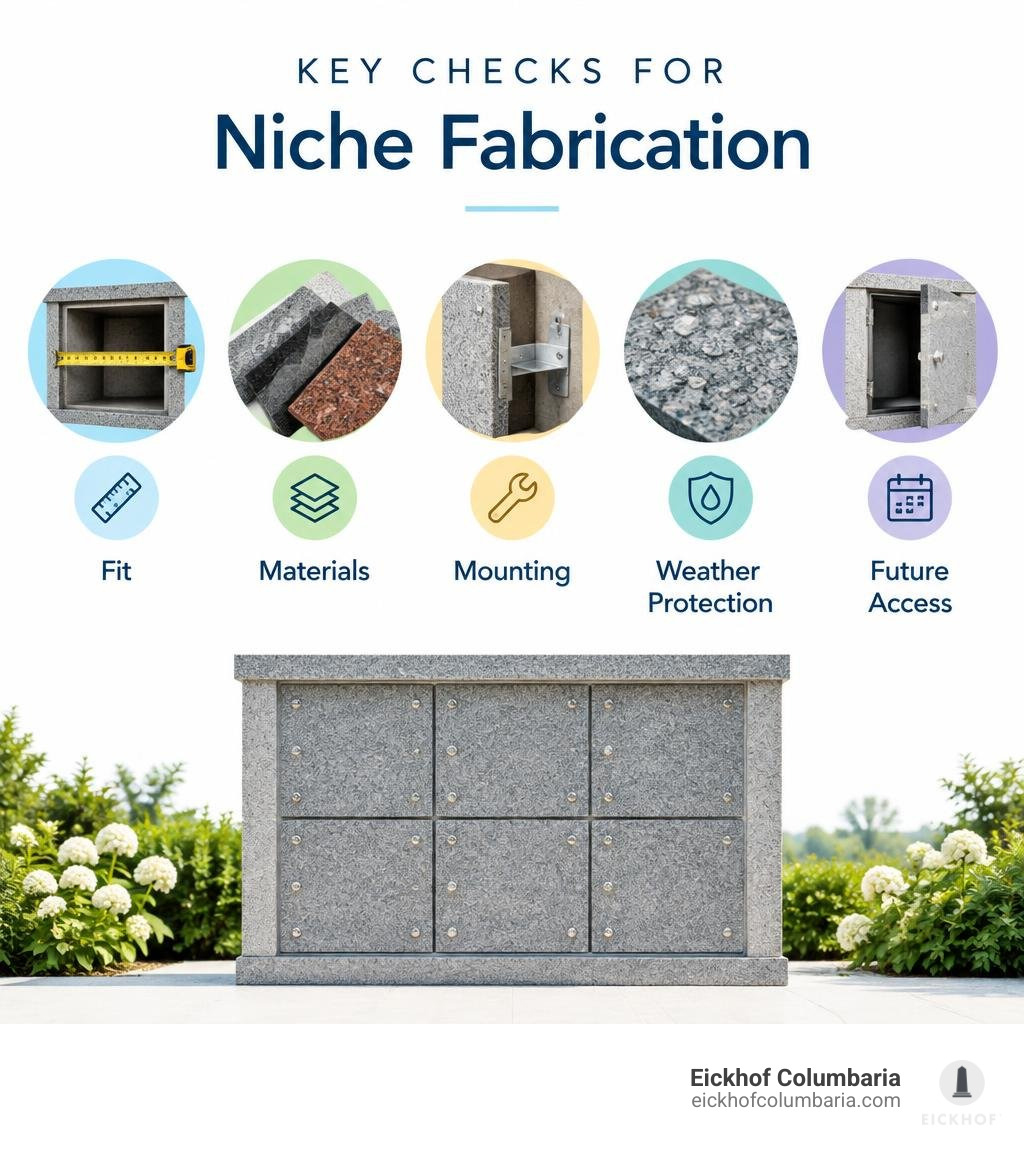
Simple guide to cremation niche fabrication terms:
Core Engineering and Cremation Niche Fabrication Standards
Memorial structures carry an emotional weight that ordinary commercial architecture never has to bear. When a family visits a columbarium, every element—from the level alignment of stone panels to the crisp edge of an engraved letter—serves as a physical testament to remembrance. Behind that dignified presentation sits rigorous industrial engineering.
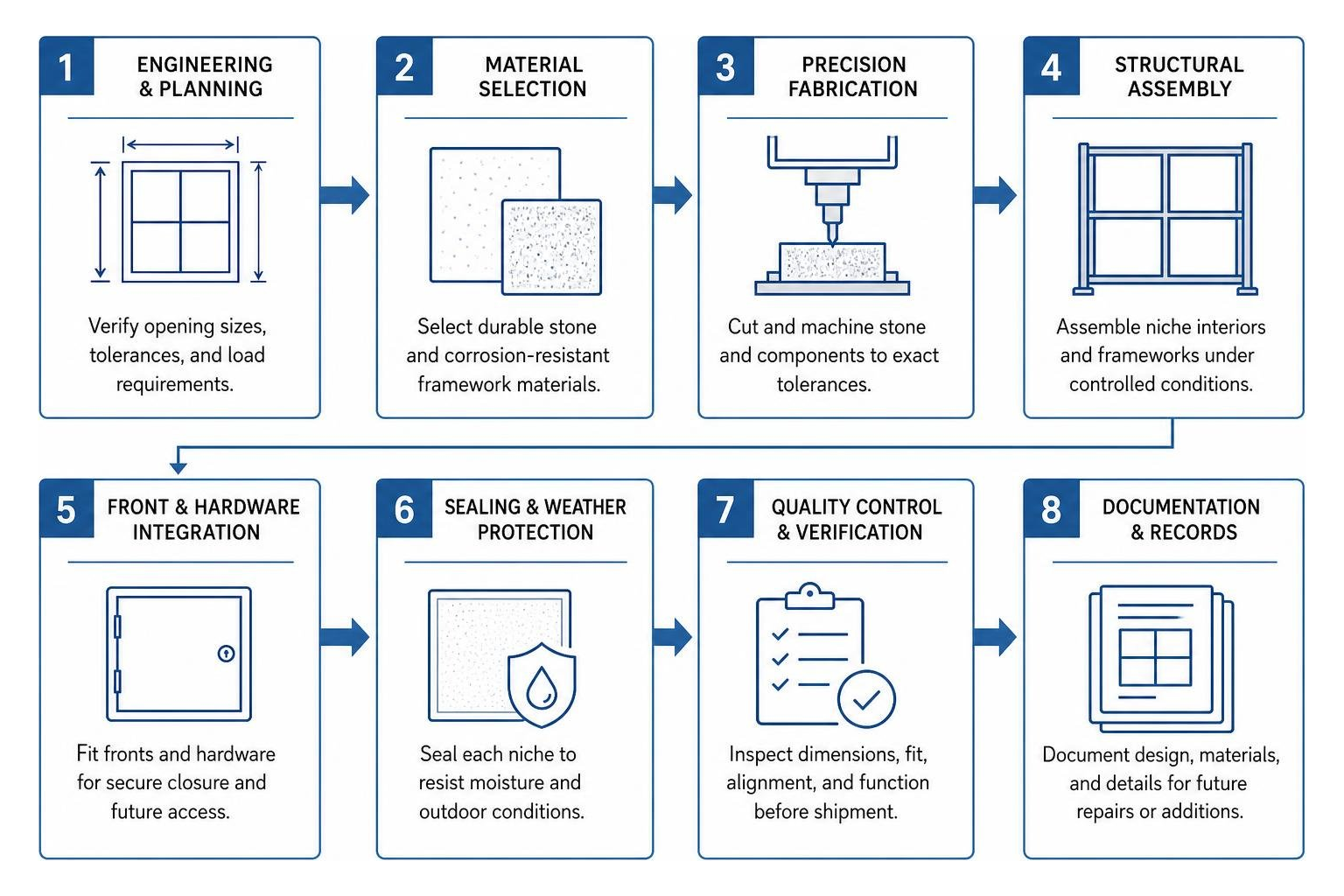
At the structural core, columbaria require zero-tolerance sizing. Individual compartments must maintain absolute squareness across multi-tiered configurations. Any slight variance in a lower tier compounds as rows stack upward, which can lead to binding hardware, uneven reveal lines, or moisture ingress. We build load-bearing frameworks capable of supporting massive dead loads of granite or bronze cladding alongside severe environmental forces like seismic activity and wind shear.
Modern engineering relies heavily on modularity. Utilizing pre-assembled niche structures built for long-term durability allows us to manufacture inner compartments under controlled factory conditions. Structural frameworks fabricated from high-grade structural aluminum or heavy-gauge stainless steel eliminate the environmental contamination and dimensional inconsistencies common to field-poured concrete. By controlling these parameters in the shop, we ensure each interior niche space maintains uniform volumetric capacity, fitting standard urn sizes or companion arrangements without friction.
Precision Stone Cremation Niche Fabrication Methods
Transforming raw geological slabs into precision memorial fronts demands a balance of heavy machinery and artisanal care. Granite selection begins with density and absorption testing. For outdoor environments subject to freeze-thaw cycles, stone must exhibit minimal water absorption (typically under 0.2%) and high compressive strength to prevent micro-fracturing over decades.
Once selected, raw slabs pass through multi-axis CNC bridge saws and diamond profiling wheels. Edge beveling must remain consistent down to fractions of a millimeter across hundreds of consecutive panels. Understanding what makes a great cemetery niche design involves recognizing that tight tolerances prevent rainwater from pooling on stone ledges while ensuring that surrounding shadow gaps remain uniform across the entire face of the wall.
Stone Niche Front Fabrication Protocols
Fabricating stone niche fronts requires exact dimensional templating. Unlike standard architectural tile or cladding, a niche front serves as an operational door that cemetery personnel will open and reseal during future interments.
Our manufacturing protocols account for:
- Verified Opening Dimensions: Ensuring every stone front provides adequate clearance for concealed mounting hardware without binding against adjacent panels.
- Edge Calibrations: Eased, polished, or beveled edges that resist chipping during handling and maintenance access.
- Display Enclosure Depth: Balancing exterior stone thickness (typically 3/4-inch to 1-inch granite) with interior usable depth to maximize urn capacity.
- Pre-drilled Fixing Interfaces: Utilizing CNC waterjet drilling to place mounting points precisely on the reverse side of stone panels, supporting systems detailed in our pre-assembled columbarium units and hardware selection overview.
Material Selection: Durability, Aesthetics, and Production Costs
Selecting the appropriate material balances aesthetic goals, climatic demands, and project budgets. Granite remains the undisputed gold standard for outdoor columbarium fronts due to its extreme hardness and resistance to acid rain. Cast bronze panels and plaques offer classic warmth and age with a natural patina (some call it the metal’s way of getting distinguished grey hair), while stainless steel or aluminum inserts provide clean accents for contemporary or indoor mausoleum installations.
| Material Variety | Common Finishes | Relative Fabrication Cost | Production Lead Time | Outdoor Weatherability Rating |
|---|---|---|---|---|
| Deep Black Granite (e.g., Absolute Black) | Polished, Honed, Thermal | Medium to High ($200–$600 per front) | 4–6 Weeks | Exceptional (Resists fading, ideal for laser etching) |
| Grey / Pink Granite (e.g., Barre Gray, Mountain Rose) | Polished, Rock-pitch, Sawn | Moderate ($200–$500 per front) | 4–6 Weeks | Exceptional (Low thermal expansion, high density) |
| Architectural Cast Bronze | Hand-rubbed Patina, Polyurethane Clear Coat | High ($300–$700 individual, $500–$1,200 companion) | 8–12 Weeks | High (Requires periodic clear-coat maintenance) |
| Marine-Grade Aluminum / Stainless | Anodized, Brushed, Powder-Coated | Moderate ($150–$400 per panel) | 3–5 Weeks | High (Best suited for dry climates or indoor columbaria) |
Evaluating these materials early helps prevent surprises later when balancing project scope against demystifying outdoor columbarium niche and maintenance pricing.
Stone Front Specifications
Granite fronts destined for memorial niches undergo diamond-grit polishing stages up to a 3000-grit mirror finish or a smooth, non-reflective honed surface. Hand-finishing ensures that arrises (the sharp edges where two surfaces meet) are relieved to prevent snapping during handling.
Standard individual niche fronts typically measure approximately 11 inches wide by 4 inches tall or 12 inches by 12 inches, depending on whether the stone acts as a decorative cover plaque or the primary structural closure panel. Companion niche fronts, designed to cover space for two urns, generally measure 11 inches by 8 inches, 12 inches by 6 inches, or larger double-niche configurations (such as 12 inches by 24 inches).
Inscriptions, Bas-Relief Emblems, and Portrait Insets
Memorialization requires legible, permanent lettering techniques that remain sharp for generations:
- V-Carve Mechanical & Sandblast Engraving: Sandblasting stone masked with computerized vinyl stencils creates deep V-cut lettering that casts natural shadows, ensuring readability in all lighting conditions.
- Laser Etching: Applied primarily to high-density black granites, lasers vaporize the polished surface to expose unpolished, bright micro-fractures, producing high-detail portraits and scenes.
- Cast Bronze Bas-Relief Emblems: Military ribbons, religious emblems, or civic insignias cast directly into bronze overlays add tactile depth.
- Porcelain Ceramic Portraits: True kiln-fired ceramic photo insets (ranging from $500 to $1,000 for bronze-and-ceramic combinations) resist UV fading, provided that artwork is supplied at a minimum of 300 DPI resolution.
To preserve aesthetic uniformity across a cemetery wall over decades, fabricators must carefully record font styles, letter depths, and kerning formulas in permanent project archives.
Mounting Hardware, Weatherproofing, and Serviceability
A niche closure system must achieve two opposing goals: it must permanently resist weather, vandalism, and shifting, yet allow cemetery staff to open it cleanly without damaging adjacent niches.
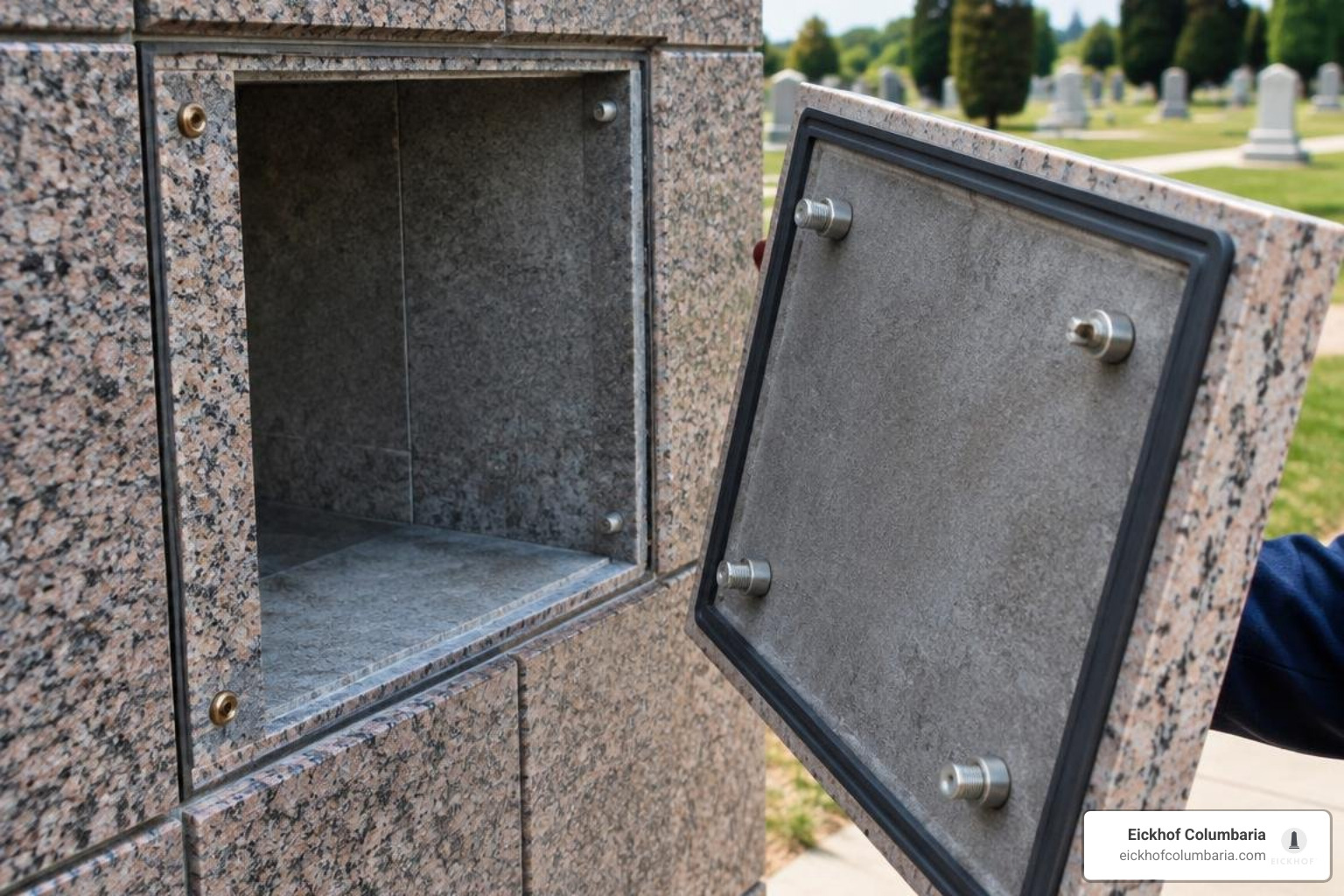
Surface-mounted rosettes and exterior security screws were common in older columbarium systems, but modern engineering favors concealed mechanical hardware. Rosettes expose metal fasteners to rainfall, causing oxidation streaks down stone faces. Exposed screws also present a vandalism risk.
By utilizing blind studs secured into the reverse side of stone panels, we create an unbroken, clean exterior face. These mechanical attachments mate directly into precision-engineered columbarium frames, which allows cemetery personnel to utilize specialized vacuum lifting tools or concealed security keys to open the compartment. This ensures you select permanent columbarium niche holders that meet cemetery rules without sacrificing aesthetics or security.
Weather Resistance and Future Access Design
Outdoor columbaria face relentless environmental cycling. Direct sunlight causes thermal expansion in stone, followed by rapid cooling during rainstorms. Without proper engineering, moisture drawn into the niche interior can cause urn degradation or structural mildew.
Our weatherproofing protocols incorporate:
- Continuous Gasketing: Closed-cell EPDM or silicone perimeter gaskets that seal out wind-driven rain while absorbing thermal movement.
- Weep and Drainage Channels: Internal secondary drainage channels engineered into the core frame to direct any condensation safely out through the columbarium base.
- Non-Corrosive Fasteners: Exclusive use of 304/316-grade stainless steel and marine-grade aluminum components to prevent galvanic corrosion between dissimilar metals.
- Damage-Free Removal: Gasket interfaces that do not rely on wet-caulking or permanent adhesives, ensuring that opening a niche decades later does not tear the stone or leave unsightly residues.
Cemetery Compliance and FTC Funeral Rule Guidelines
Under the Federal Trade Commission’s (FTC) Funeral Rule, families maintain the legal right to select memorial items from third-party fabricators rather than purchasing solely through the cemetery, provided those items meet the cemetery’s established technical specifications.
Cemeteries establish strict rules regarding niche dimensions, plaque thicknesses, stone colors, and typography to maintain visual cohesion across their grounds. Furthermore, cemeteries commonly charge setting or administrative fees (typically ranging from $50 to $200) to review specifications, oversee delivery, and perform the physical installation. Fabricators must coordinate closely with cemetery operators, adhering to a clear walkthrough of columbarium structures and purposes to ensure that all delivered stonework and hardware seat into the cemetery’s infrastructure.
Maintenance and Preservation for Memorial Fronts
Properly fabricated columbaria require minimal intervention, but routine preservation keeps stone and metal looking their best over generations:
- Stone Surface Care: Wash polished granite fronts using clean water and mild, non-ionic cleaners. Avoid harsh acids, muriatic washes, or high-pressure power washers, which can strip polished surfaces and erode protective sealers.
- Bronze Plaque Maintenance: Bronze plaques feature a protective clear coat over hand-rubbed patinas. Clean gently with soft microfiber towels and water. Reapplying a microcrystalline wax or fluoropolymer clear coat every few years prevents the patina from darkening into green copper carbonate prematurely.
- Gasket & Seal Inspections: Annually inspect perimeter joints for physical integrity. Ensure that weep holes along the base of the structure remain clear of grass clippings, mulch, or insect nests.
- Hardware Verifications: During an interment opening, inspect interior blind studs and mechanical receivers for smooth operation before resealing the niche.
Frequently Asked Questions About Cremation Niches
How long does it take to manufacture and deliver custom niche structures?
Standard fabrication of cast bronze niche plaques typically requires 8 to 12 weeks due to mold-making, pouring, chasing, patina application, and oven-curing protective clear coats. Granite niche fronts and modular columbarium wall systems generally require 4 to 8 weeks depending on stone quarrying and custom engraving schedules. Rush orders can often be accommodated in 5 to 10 business days for expedited lettering on pre-cut stock.
Can a columbarium configuration be customized for a cemetery project?
Yes. Columbarium engineering supports a broad range of architectural arrangements, including curved walls, double-sided walkways, circular walk-arounds, and integrated memorial garden benches. Custom fabrication accounts for site topography, cemetery setbacks, local wind load codes, and future expansion phases.
What are the main benefits of concealed-hardware niche systems?
Concealed-hardware systems hide fasteners behind the stone face. This design creates a clean, dignified aesthetic while eliminating the rust stains often caused by exposed metal rosettes. Furthermore, concealed mechanisms enhance security against tampering and protect critical locking hardware from rain, ice, and salt-air exposure.
Conclusion
At Eickhof Columbaria, we believe that precision engineering in memorial fabrication is an act of compassion. When every stone front aligns, every seal holds against the weather, and every inscription is cut with lasting clarity, a columbarium becomes an enduring place of solace for generations of families.
Whether you are designing a new cemetery development, expanding a church memorial garden, or seeking answers to everything families need to know about choosing a cremation niche, focusing on material quality, precision tolerances, and concealed-hardware longevity ensures your project stands the test of time.