

What Is the Columbarium? Definition, Origin, and Purpose
To truly understand the modern memorial landscape, many families start by asking, what is the columbarium and how does it fit into contemporary funeral planning? At its core, a columbarium is a permanent, above-ground structure designed specifically for the respectful entombment of cremated remains. Unlike a traditional burial plot where an urn or casket is placed in the earth, a columbarium features a grid of individual, secure compartments known as niches. Each niche houses one or more cremation urns, acting as a personal, above-ground memorial space.
The primary purpose of a columbarium is to provide an accessible, dignified, and lasting sanctuary where families can gather, reflect, and pay tribute to their loved ones. As cremation rates continue to rise across the United States, communities are increasingly understanding resting places beyond traditional in-ground burial. A columbarium fulfills both practical and emotional needs: it maximizes land efficiency for cemeteries and churches while giving families the comfort of a dedicated, perpetual memorial site that requires minimal landscape upkeep.
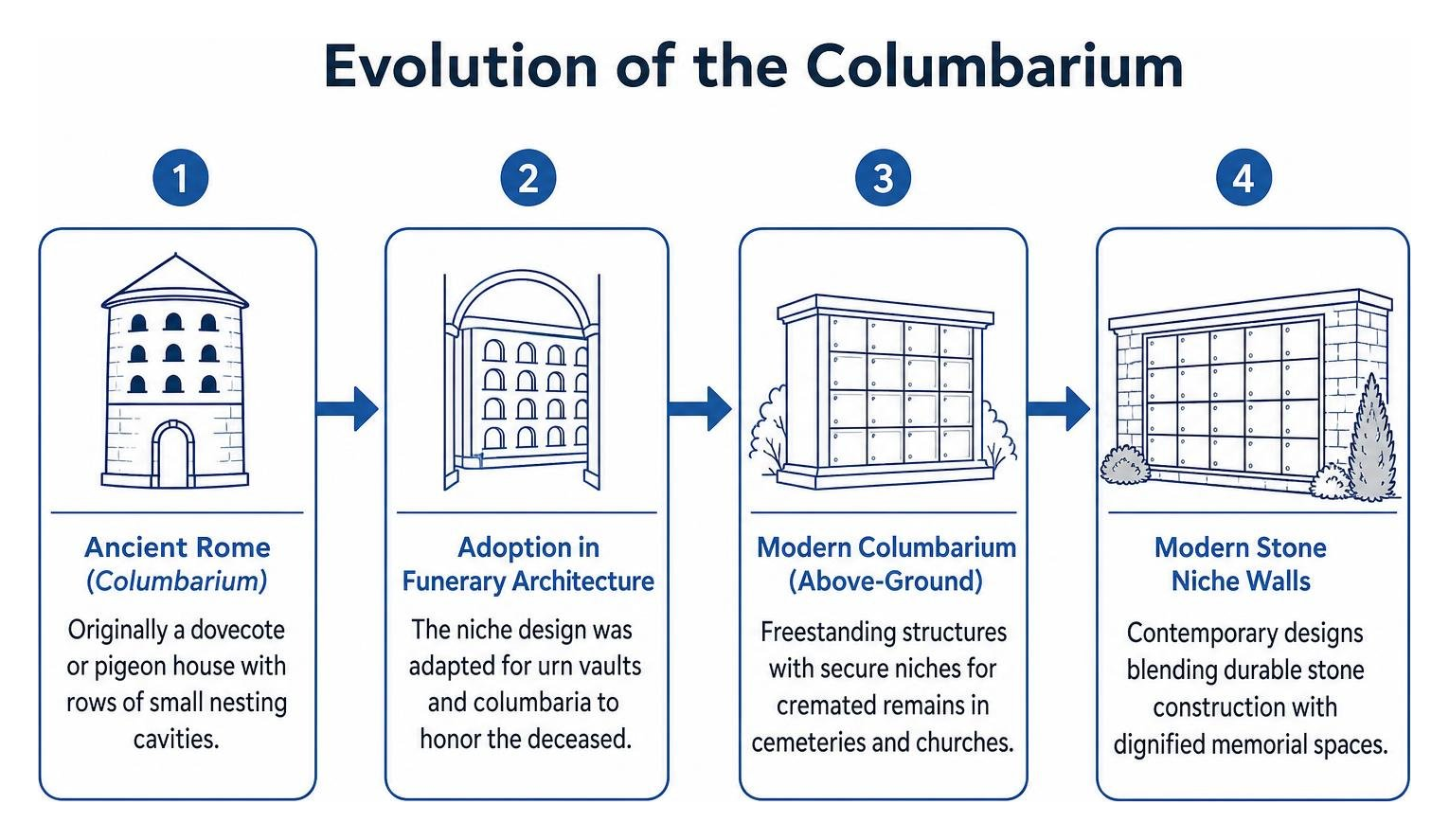
Clarifying Terminology: What Is the Columbarium vs Columbary?
Language enthusiasts and church committees often encounter two very similar words: columbarium and columbary. While they share the exact same etymological root, their modern applications can differ slightly depending on context.
The term originates from the Latin word columba, which translates to “dove.” In antiquity, a columbarium (plural: columbaria) originally referred to a dovecote or pigeon house—a building filled with small wall cavities where birds could roost and nest. Over the centuries, the term was adopted into funerary architecture because the neat rows of niches inside an urn vault bore an uncanny resemblance to those nesting boxes.
According to the definition in the Cambridge English Dictionary, a columbarium is officially recognized as a room or building with niches for holding urns containing the ashes of cremated people. The word columbary serves as an older, alternate English variant of the same word. In historical architectural contexts, a columbary may still refer to a physical dovecote or pigeon loft found on historic European estates. However, in modern ecclesiastical and cemetery discussions, columbarium has become the standard, universally recognized term for a sacred urn resting place.
Ancient Roots: What Is the Columbarium Historical Context?
The practice of building dedicated niche structures for cremation ashes is far from a modern invention. In the early Roman Empire, cremation was the predominant funerary practice. Wealthy Roman families, burial societies, and trade guilds constructed elaborate subterranean vaults to house hundreds of urns. One of the most famous preserved historical examples is the Columbarium of Pomponius Hylas, discovered near the Porta Latina in Rome. Built in the first century AD, this underground chamber was richly decorated with vibrant frescoes, intricate mosaics, and detailed stucco work that celebrated the lives of those entombed within.
Far from being dark or somber, Roman columbaria were treated as reverent, celebratory spaces. Around the same period in Asia, Buddhist traditions embraced similar concepts. Attached to temples and sacred grounds, spaces known as nōkotsudō in Japan were established to house the cremated ashes of monks and devout followers, keeping their spirits close to daily prayers and sacred rituals.
Throughout the Middle Ages and early modern period, when in-ground casket burial became the dominant Christian tradition in Europe, the term slipped back toward its agrarian roots. However, the late 19th and early 20th centuries saw a massive revival of cremation and columbarium construction worldwide, evolving from subterranean brick vaults into the elegant, weather-resistant stone structures we design and manufacture today.
Columbarium Niche Configurations and Memorialization Considerations
When planning a resting place, understanding how niches are configured helps families make informed choices that fit their long-term desires. Niches are engineered in several standardized configurations to accommodate individual needs, married couples, or entire generations of a family.
For many people, columbarium memorials explained for families considering cremation bring clarity to the emotional benefits of above-ground entombment. Choosing a niche provides an anchor—a physical location where children, grandchildren, and friends can visit year after year.
The table below outlines the primary niche configurations available in modern memorial planning:
| Niche Configuration | Standard Urn Capacity | Common Applications | Key Benefits |
|---|---|---|---|
| Single Niche | 1 Urn | Individual memorialization | Cost-effective, compact footprint, highly focused personal tribute |
| Companion Niche | 2 Urns | Spouses, partners, or siblings | Keeps loved ones together, shared inscription face, efficient space use |
| Family / Estate Niche | 3 to 4+ Urns | Multi-generational family placement | Unified family legacy, long-term planning security, cost savings per urn |
Beyond urn capacity, the physical location of the niche within the structure—often referred to as the “tier”—plays a significant role in selection. Niches positioned at eye level (frequently called the “touch zone” or “heart level”) are often selected first by families because they provide immediate intimacy during visits. Higher or lower tiers offer the exact same structural protection and dignity, often at a more accessible price point.
Structural Types, Materials, and Niche Design Features
Columbaria are versatile structures that can be custom-tailored to suit any architectural or natural environment. Whether designed for a tranquil outdoor churchyard or an indoor mausoleum corridor, the chosen construction materials dictate both the structure’s longevity and its aesthetic appeal.
Modern columbaria fall into several primary structural categories:
- Freestanding Outdoor Columbaria: Standalone monuments, octagonal towers, or sweeping curved walls set within memorial gardens, churchyards, or cemetery lawns.
- Indoor Columbarium Walls: Climate-controlled installations located inside churches, chapels, cathedral crypts, or mausoleums.
- Integrated Structural Walls: Columbaria engineered directly into the perimeter walls, retaining structures, or entry facades of an existing building.
To ensure that each structure endures the elements for generations with minimal maintenance, selecting high-grade materials is paramount. Granite remains the gold standard for exterior columbarium construction due to its exceptional density, compressive strength, and resistance to freeze-thaw cycles. Marble is frequently chosen for interior sanctuary installations, offering refined veining and a bright, classical finish.
Inside the structure, niche compartments are typically fabricated from heavy-gauge aluminum or structural core materials that prevent moisture intrusion and structural warping. At Eickhof Columbaria, we specialize in handcrafted stone systems with concealed hardware. By eliminating visible exterior screws, rosettes, and brackets, our niche faces present a clean, seamless architectural facade that maximizes security and visual serenity.
For those selecting individual units, reviewing a helpful guide to single niche columbarium options and capacity ensures the internal dimensions comfortably fit your selected urn style.
Niche face designs also provide distinct aesthetic choices:
- Polished Granite or Stone Fronts: Offer a traditional, opaque appearance where names, birth dates, and personalized epitaphs are crisply sandblasted or bronze-cast directly onto the stone.
- Glass-Front Niches: Exclusively used in indoor, climate-controlled environments, glass fronts allow visitors to view the decorative urn alongside small personal mementos, photographs, or heirloom keepsakes.
Before finalizing a niche, families often find that everything families need to know about choosing a cremation niche helps them match interior urn dimensions with exterior face styling.
Cultural Significance, Religious Traditions, and Locations
The placement of a columbarium is deeply intertwined with cultural values and religious customs. Far from being simple storage walls, these installations serve as sacred gathering spaces across diverse faiths and municipal settings.

In the Christian tradition—particularly within the Roman Catholic Church, Episcopal, Lutheran, and Methodist denominations—the connection between the church building and the cemetery has deep historical roots. In 2016, the Vatican issued clear instructions regarding cremation (Ad resurgendum cum Christo), affirming that while cremation is entirely permitted, the cremated remains must be laid to rest in a sacred, consecrated place—such as a cemetery or church columbarium—rather than scattered or kept permanently at home. Incorporating a columbarium into a church courtyard or crypt allows parishioners to return to their spiritual home for eternity, surrounded by the prayers of their active community.
In Buddhist cultures, temple columbaria remain central to ancestral veneration. Families regularly visit temple nōkotsudō during festive and memorial holidays such as O-Bon to offer incense, flowers, and prayers, maintaining a continuous bond between the living and the deceased.
Today, these installations are common across a variety of settings:
- Churches and Religious Sanctuaries: Nestled in memorial courtyards, prayer gardens, or indoor prayer chapels.
- Municipal and Private Cemeteries: Integrated as standalone monument gardens or expansive outdoor niche plazas. In fact, many cemeteries are expanding rapidly; one notable urban installation added 20,000 spots to accommodate long-term civic demand.
- Veterans Memorial Cemeteries: Serving as central civic landmarks honoring military service with standardized bronze plaques and flags.
- Universities and Civic Parks: Offering alumni and community members a dedicated place of remembrance on historic grounds.
Exploring a practical guide to columbarium services across America shows how churches and cemeteries nationwide successfully adapt these sacred spaces to their local communities.
Columbarium Costs, Pricing Factors, and Practical Advantages
When comparing final arrangement options, choosing a columbarium niche offers significant practical, environmental, and financial benefits over traditional ground burial. A complete in-ground burial involves purchasing a plot, an expensive casket, an outer burial vault, grave opening and closing fees, and an upright headstone or flat marker.
By contrast, a columbarium consolidates these elements into a single, permanent structure. Historically, early cremation advocates observed that the cost of a plain furnace with a columbarium did not exceed $5,000—a mere trifle when compared with the ongoing land acquisition costs of traditional burial grounds. Today, that cost-effectiveness directly benefits families and cemeteries alike.
The cost of a columbarium niche generally starts at around $700 and can go up to $2,200 or more depending on several key factors:
| Pricing Factor | Impact on Cost | Details to Consider |
|---|---|---|
| Niche Size & Capacity | Moderate to High | Single niches are the most economical ($700–$1,200); companion and family niches range higher ($1,500–$2,200+). |
| Indoor vs. Outdoor | Moderate | Indoor, climate-controlled glass niches often carry a premium over standard outdoor granite niches. |
| Tier Level (Height) | Low to Moderate | Eye-level (“heart level”) niches typically command higher prices than bottom or top tiers. |
| Perpetual Care Fees | Variable | Many cemeteries include a mandatory 10–15% endowment care fee to guarantee perpetual upkeep. |
| Engraving & Personalization | Low to Moderate | Custom sandblasted lettering, laser-etched portraits, or cast bronze plaques add to the final cost. |
Choosing a columbarium also provides emotional advantages over simply keeping an urn on a mantelpiece at home. While keeping ashes at home is common immediately after a loss, it can lead to long-term anxiety regarding accidental spills, damage from household moves, or uncertainty about what future generations will do with the urn. A columbarium niche ensures permanent security, spill-proof protection, and a dignified place of tribute that remains undisturbed forever.
For a comprehensive review of budget considerations, our realistic columbarium niche cost breakdown provides transparent insight into planning your arrangements.
Frequently Asked Questions About Columbaria
Can a single columbarium niche hold multiple urns?
Yes, depending on the internal dimensions of the niche and the size of the urns. While standard single niches are engineered to hold one standard 200-cubic-inch adult urn, companion niches are specifically sized to hold two urns side-by-side or front-to-back. Many families opt for compact or sheet-bronze urns to comfortably place two or more sets of remains within a single companion space, provided cemetery bylaws permit it.
Where are columbaria most commonly built?
Columbaria are most frequently constructed in municipal and private cemeteries, church memorial gardens, cathedral crypts, and military memorial parks. Because they occupy a compact physical footprint, they can be installed in tranquil church courtyards, along cemetery garden paths, or inside dedicated mausoleum chapels.
What are the benefits of concealed-hardware stone niches?
Concealed-hardware systems use internal structural clips and precision tracks rather than exterior rosettes, screws, or bolts to secure the niche faceplate. This delivers three distinct benefits: superior weather sealing, enhanced security against tampering, and a clean, uninterrupted stone facade that highlights the natural beauty of the granite or marble.
Conclusion
Whether referred to historically as a columbary or known by its contemporary name, a columbarium represents one of the most practical, beautiful, and reverent memorial solutions available today. By combining architectural elegance with space efficiency, it provides families with peace of mind and a permanent place of remembrance.
At Eickhof Columbaria, we take pride in manufacturing handcrafted, concealed-hardware columbarium systems designed to endure for generations. If your church, cemetery, or community is considering adding a sacred memorial space, explore our clear walkthrough of columbarium structures and purposes to discover how turnkey design and precision craftsmanship can bring your vision to life.