

Choosing Companion Urns for a Shared Columbarium Niche
The best companion urns for niche placement hold two sets of cremated remains while fitting the niche’s actual clear opening, interior width, height, and depth. Before selecting an urn, confirm these four measurements with the cemetery or church, then compare them with the urn’s outside dimensions and capacity.
A practical starting point:
- Choose about 1 cubic inch of capacity per pound of body weight for each person.
- Most companion urns hold roughly 380 to 440 cubic inches.
- Leave enough physical clearance for safe placement, especially at the niche door.
- Confirm rules for urn material, closure type, and whether the niche accepts one double urn or two separate urns.
A companion urn creates one shared memorial for two people, often spouses or partners. It may have one chamber that holds both remains together, or two divided chambers that keep each person’s cremated remains separate until inurnment.
This planning matters more as cremation becomes more common. The U.S. cremation rate was projected to reach 63.4% in 2025, increasing the need for durable, space-conscious columbarium solutions. For facilities managers, the right urn is not only a meaningful family choice. It also supports orderly installation, a clean appearance, and long-term care within a limited niche space.
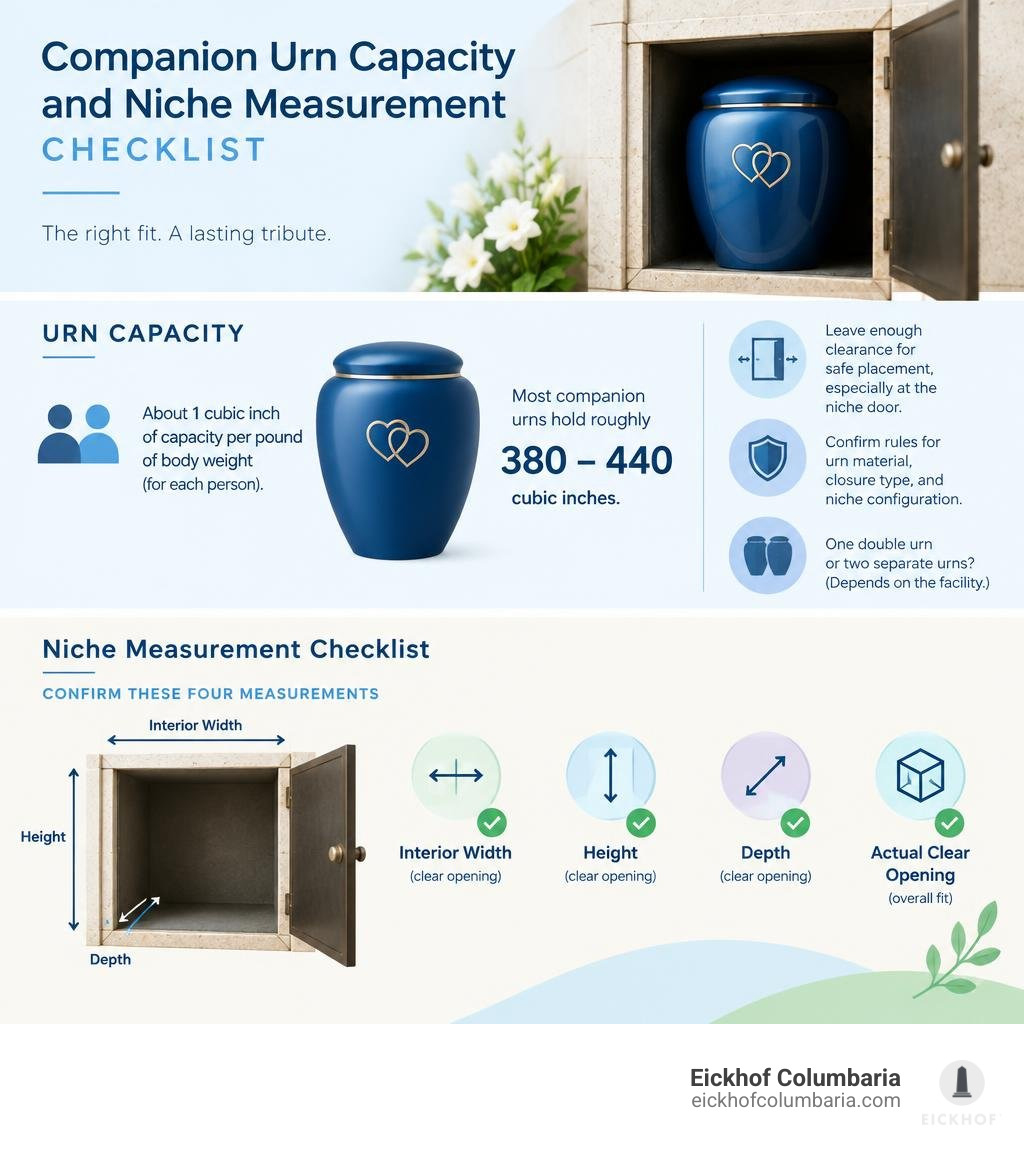
Companion urns for niche definitions:
Understanding Dimensions and Companion Urns for Niche Placement
Selecting the right companion urn requires balancing internal volume with external geometry. It is easy to assume that if an urn has sufficient interior cubic volume, it will naturally slide into a standard niche. However, internal capacity and external footprint are two entirely different metrics.
The standard rule of thumb for cremation sizing is simple: 1 pound of healthy body weight equals roughly 1 cubic inch of cremated remains. When planning for two adults, you combine both estimated weights and add a safety buffer of 10% to 20%. Most double-capacity urns are manufactured in the 380 to 440 cubic inch range, though larger models provide up to 450 or 460 cubic inches.
To ensure sizing urns for adults made easy, always verify the external dimensions (Length × Width × Height) against the actual inner dimensions of the columbarium compartment. A vessel designed with thick stone walls might hold 420 cubic inches inside while requiring 10 inches of width and 9.5 inches of depth externally.
When evaluating double vessels, keep in mind how shape influences fit:
| Urn Style & Material | Typical Exterior Dimensions (W × D × H) | Internal Capacity | Ideal Niche Dimensions | Fit Notes |
|---|---|---|---|---|
| Low-Profile Cultured Stone | 10.0″ × 9.5″ × 7.5″ | 420 cu. in. | 12″ × 12″ × 12″ | Engineered specifically for standard 12-inch cubes; low height eases hand access. |
| Cultured Onyx Dual Vessel | 10.0″ × 9.5″ × 7.5″ | 420 cu. in. | 11.5″ × 11.5″ × 10.5″ | Compact rectangular profile fits narrow pass-throughs cleanly. |
| Solid Hardwood Chest | 10.5″ × 10.25″ × 7.75″ | 450 cu. in. | 12″ × 12″ × 12″ | High-capacity hardwood; accommodates combined weights up to 425 lbs. |
| Artistic Scenic Wood Urn | 15.0″ × 12.0″ × 16.5″ | 460 cu. in. | Custom Oversized / Double Niche | High-profile decorative design; requires deep/tall custom niches or dual spaces. |
| Art Nouveau Accent Chest | 9.5″ × 9.5″ × 9.0″ | 460 cu. in. | 11″ × 11″ × 11″ | Symmetrical cube shape allows multi-directional entry into square openings. |
| Dual Individual Bronze/Stone Urns (Side-by-Side Pair) | 4.5″ × 4.5″ × 9.0″ (each) | 200–220 cu. in. (each) | 12″ × 12″ × 12″ | Flexible placement; allows independent handling and staggered inurnment. |
Measuring Clear Openings for Companion Urns for Niche Installations
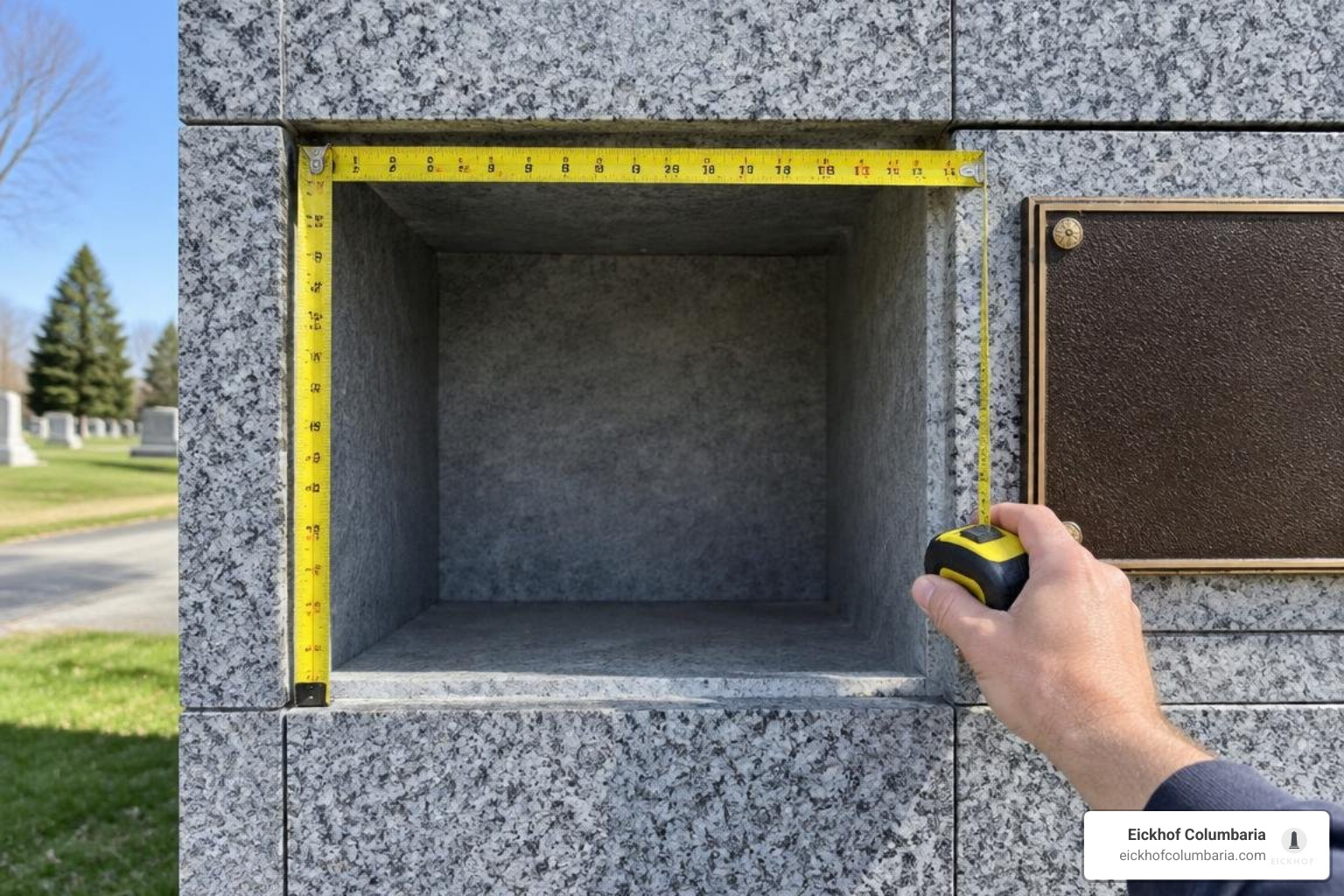
The single most common mistake families and caretakers encounter during inurnment is measuring only the interior void of the niche rather than the clear door opening.
A columbarium niche might boast an interior cavity of 12″ × 12″ × 12″, but the actual entryway can be significantly restricted by:
- Concealed or Surface Hinges: Mechanical elements that swing inward or intrude into the perimeter.
- Faceplate Borders and Flanges: Granite, marble, or bronze fascia frames that overlap the structural frame.
- Bevel Setbacks & Rosettes: Fasteners and structural clips along the inner edge.
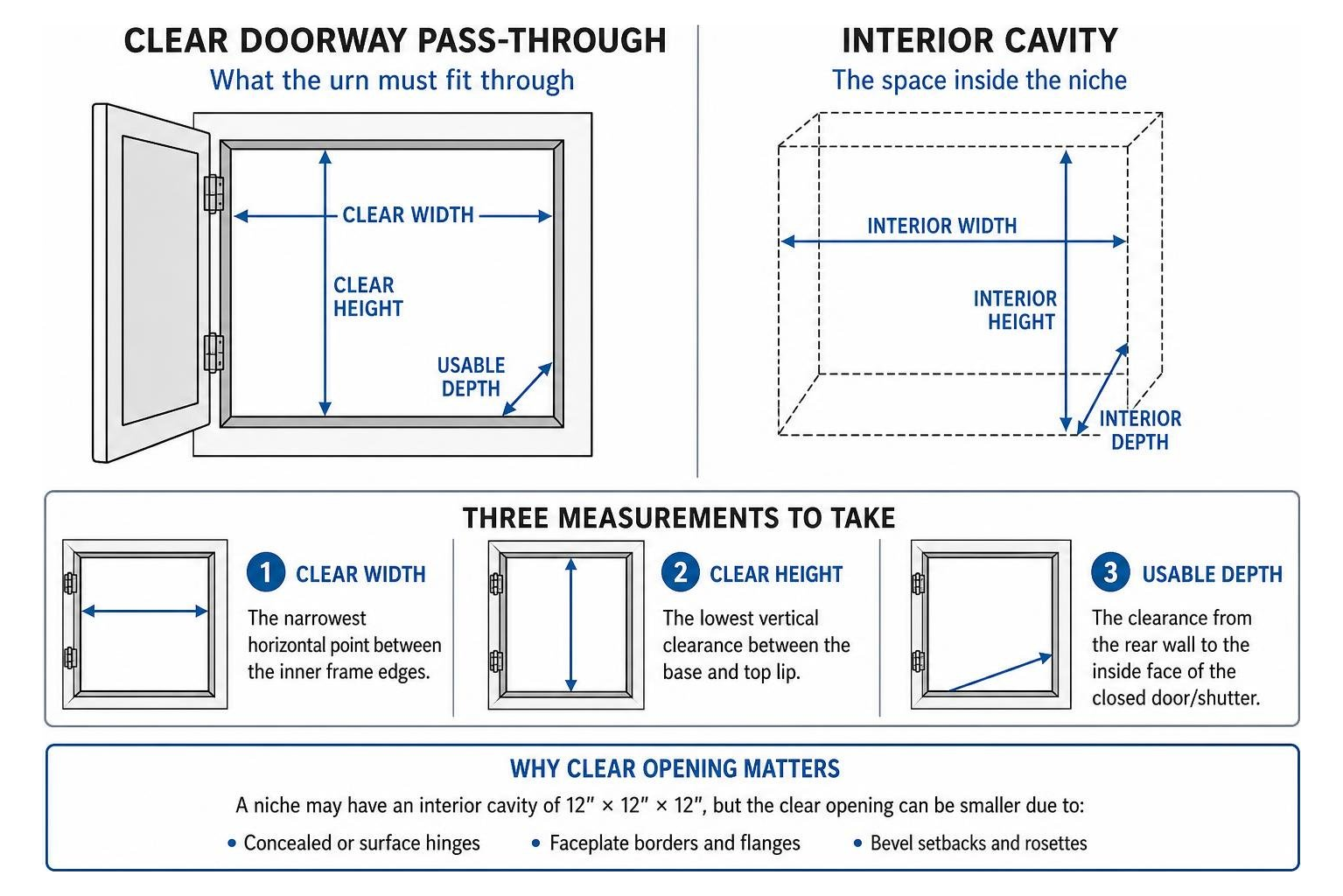
Always take three distinct sets of measurements:
- The Clear Width: The narrowest horizontal point between inner frame edges.
- The Clear Height: The lowest vertical clearance between base and top lip.
- The Usable Depth: The clearance from the rear wall to the inside face of the closed granite or glass shutter.
When choosing a cremation niche, we advise leaving at least a 0.5-inch to 1-inch clearance buffer around all sides of the urn. This margin ensures you can place hands comfortably inside to set or retrieve the vessel without scratching surrounding stone or wedging the urn in place.
Single vs. Divided Chambers in Companion Urns for Niche Spaces
Companion urns come in two functional interior configurations: single-chamber and dual-compartment designs.
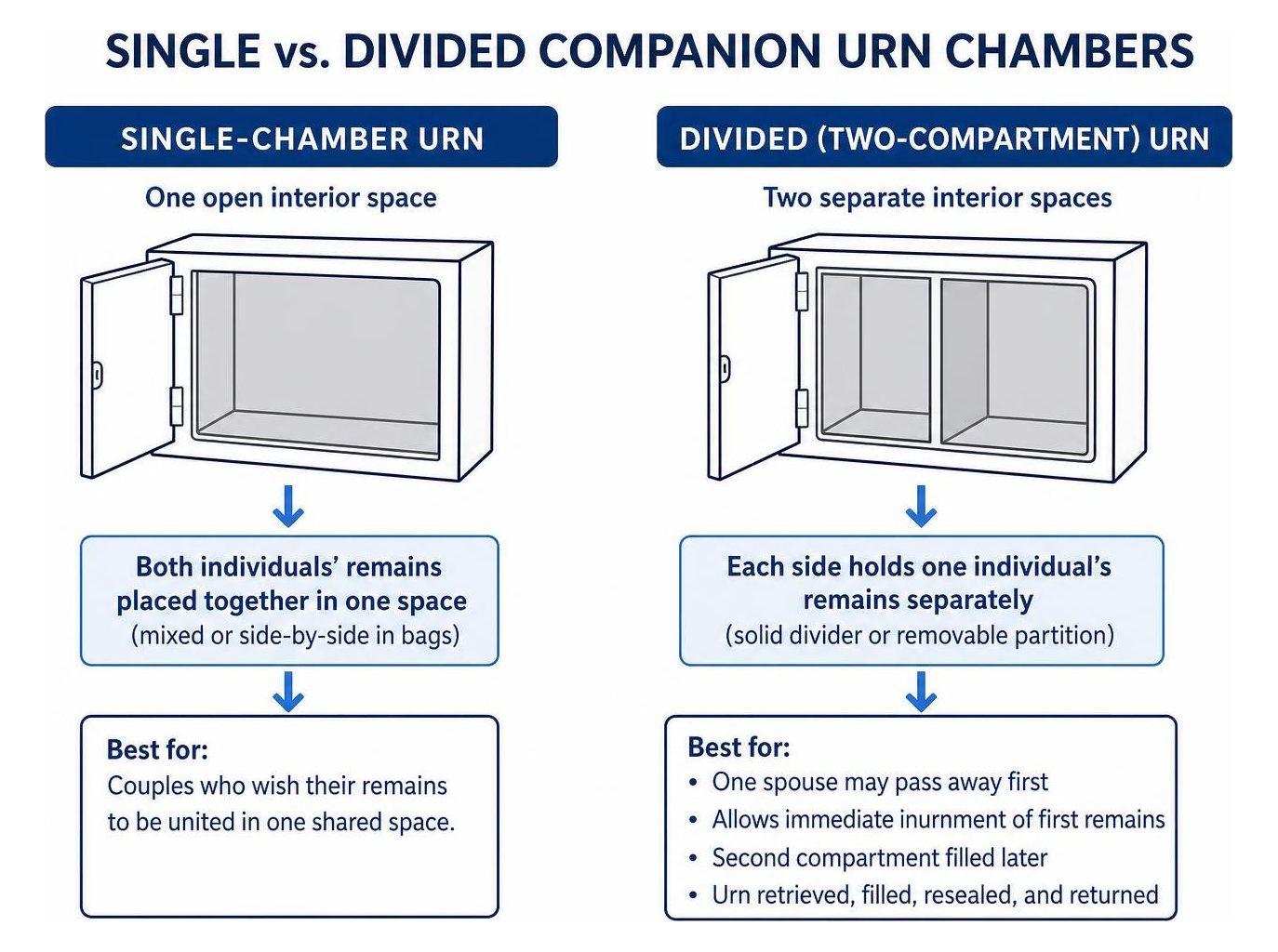
- Single-Chamber Urns: These feature one open interior compartment. The cremated remains of both individuals are placed together inside the shared space, either mixed directly or placed in side-by-side poly bags. This design holds deep symbolic meaning for couples who wish their earthly remains to be united forever.
- Divided (Two-Compartment) Urns: These vessels feature a solid central partition or a removable interior divider, such as those found in premium cherry wood models. Each side has its own access panel or internal container.
Divided chambers provide practical peace of mind when one spouse passes away before the other. The first set of remains can be safely placed in one half, allowing the vessel to be inurned in the niche immediately. When the surviving partner eventually passes, the urn can be temporarily retrieved, the second compartment filled and sealed, and the vessel returned to its shared resting place.
Best Urn Materials and Construction for Columbarium Niches
Columbaria are engineered to stand for generations, and the materials placed inside them should offer matching durability. Cemeteries, churches, and mausoleum managers frequently enforce strict rules regarding permitted materials to maintain structural stability, prevent degradation, and manage moisture.
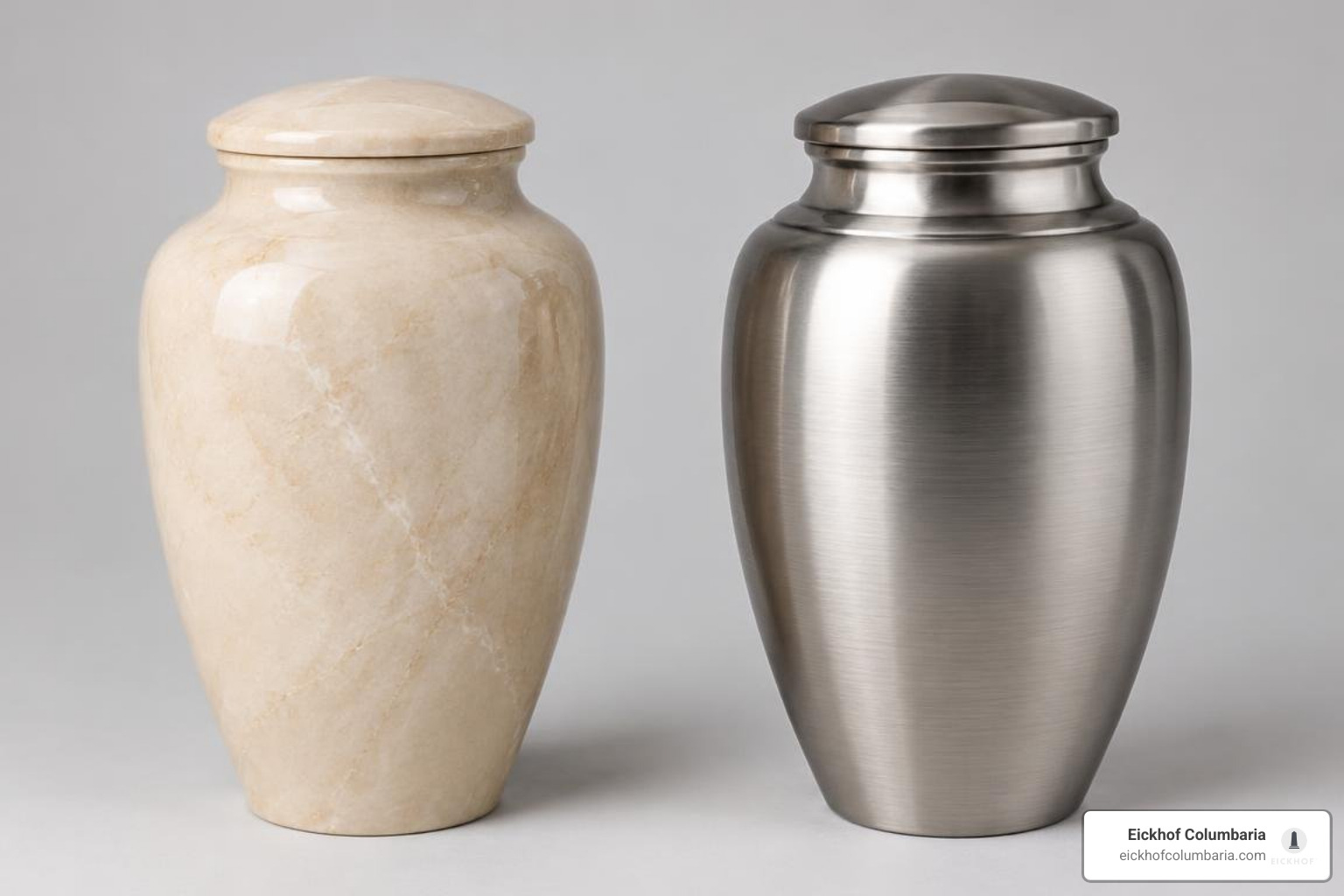
1. Cultured Marble and Cultured Stone
Engineered from a blend of genuine crushed stone (marble, onyx, or granite) and high-strength polyester resins, cultured stone represents the gold standard for columbarium placement. Cultured stone companion urns are cast into seamless, rigid vessels that resist moisture, humidity fluctuations, and pressure. They naturally meet burial vault crush-resistance standards while sliding smoothly into standard granite-front niches.
2. Cast Bronze and Stainless Steel
Cast bronze, sheet bronze, and aerospace-grade stainless steel are virtually impervious to time. Bronze develops an appealing patina and resists oxidation when sealed with protective lacquer. Sheet bronze niche boxes offer maximized internal cubic volume with very thin exterior walls, making them ideal when niche dimensions are exceptionally tight.
3. Solid Hardwoods (Cherry, Oak, Walnut, Mahogany)
Hardwood urns add rich, natural warmth. When kept inside dry, climate-controlled indoor columbaria or church chapels, hardwood can endure indefinitely. However, in outdoor columbaria subject to extreme seasonal humidity shifts, unprotected wood can swell or suffer finish damage. Always verify cemetery bylaws, as some outdoor facilities disallow bare wood urns unless enclosed inside an outer niche liner.
4. Natural Granite and Marble
Carved from solid blocks of natural stone, these urns provide weight, elegance, and natural veining. While exceptionally durable, solid stone urns possess thicker walls, which reduces internal volume relative to their overall exterior size.
Personalization, Engraving, and Sharing Strategies for Couples
A companion urn serves as a dual tribute, requiring thoughtful planning for names, significant dates, and personal messages.
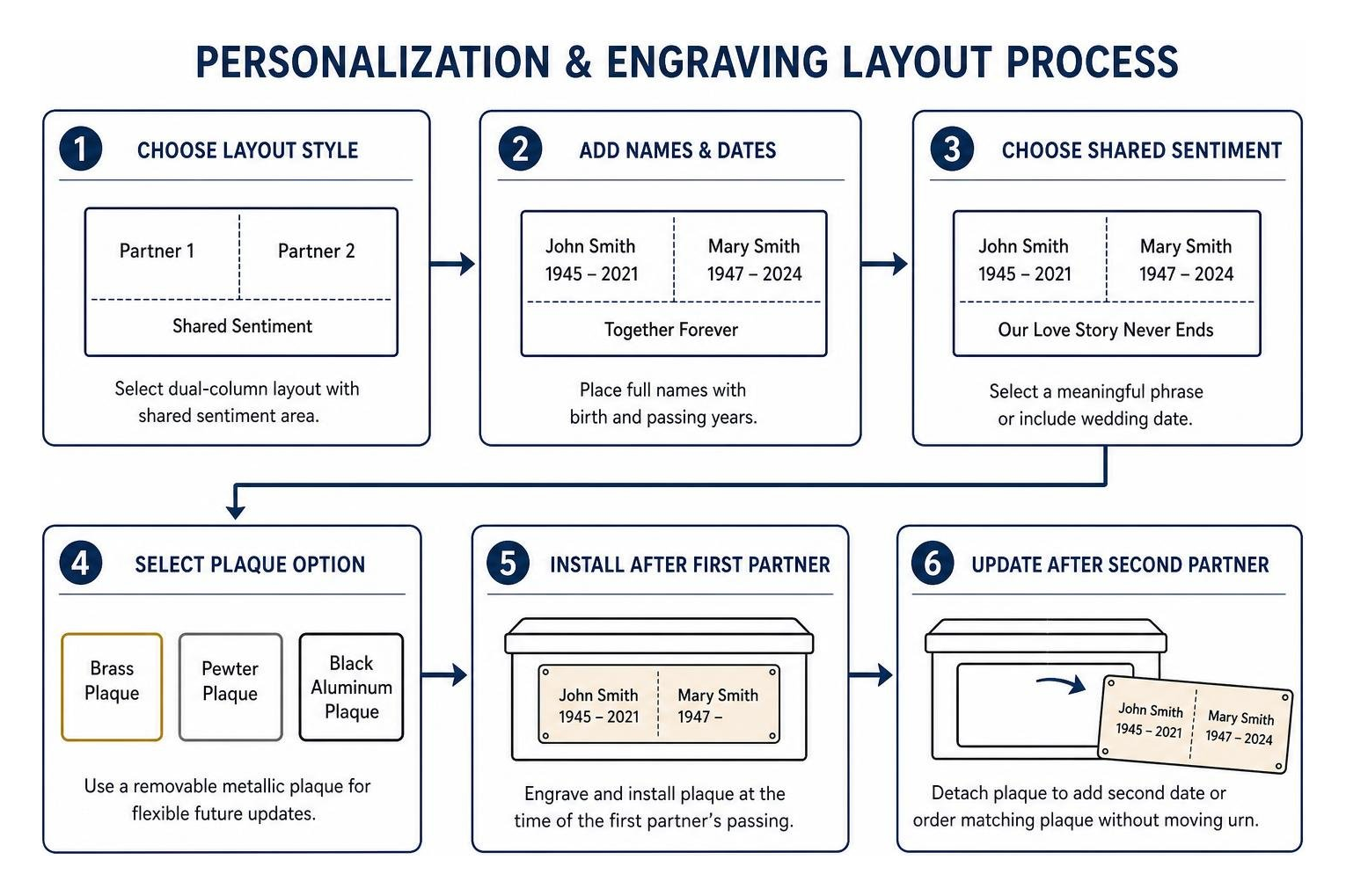
When selecting personalized urns for adults, families typically balance layout aesthetics with practical timing:
- Dual-Column Layouts: The traditional format places the husband or first partner on the left and the wife or second partner on the right, listing full names, birth years, and passing years.
- Shared Sentiments: Centered between or below the names, couples often engrave meaningful phrases such as “Together Forever,” “Our Love Story Never Ends,” or wedding dates celebrating a lifetime of marriage.
- Removable Metallic Plaques: If an urn is purchased at the time of the first spouse’s passing, engraving the raw stone or wood directly can create challenges later (such as finding an engraver willing to handle an urn containing ashes). Using attached brass, pewter, or black aluminum nameplates allows the family to detach the plate or order a matching second plate decades later without moving the vessel.
- Omitting Final Dates: Some couples choose to engrave only their names, birth dates, and marriage date, purposefully omitting the death year to keep the memorial focused on their shared life rather than their passing.
For families exploring columbarium memorials explained, companion niches also work smoothly with split-memorial arrangements. If children or grandchildren wish to keep a small portion of ashes close to home, a nominal amount can be placed into matching keepsake urns or cremation jewelry pendants before the primary companion urn is sealed and placed in the niche.
Frequently Asked Questions About Companion Niche Urns
Can two separate urns be placed in a companion niche instead of one double urn?
Yes, provided the interior dimensions of the niche and cemetery rules allow it. Many companion niches measure 12″ × 12″ × 12″ or larger, easily accommodating two slender individual urns (such as vertical bronze book urns, sheet bronze cylinders, or slim wood chests) placed side by side or stacked front-to-back.
When reviewing columbarium services across America, cemetery policies vary: some facilities charge an opening-and-closing fee for each separate inurnment, while others require a single unified container. Always ask the sexton or property administrator for their specific double-inurnment protocol.
How do families handle engraving when one partner passes away first?
When one partner passes away first, families generally choose one of three approaches:
- Pre-Engrave Everything Except the Final Passing Date: Both full names, birth dates, and wedding dates are engraved immediately. When the second partner passes, an on-site mobile laser engraver adds the final date, or the urn is briefly brought to a local monument workshop.
- Use Detachable Plaques: Opt for high-grade adhesive or screw-mounted metal nameplates. When the second partner passes, only the metal plate is shipped to the engraver, eliminating the risk and logistics of transporting an occupied urn.
- Engrave a Unified Legacy Message: Engrave names and wedding dates only, leaving passing years off the urn entirely and recording those dates on the exterior niche faceplate.
Are companion niche urns approved for air travel and TSA screening?
Yes, many companion urns can travel via commercial airlines, provided they comply with Transportation Security Administration screening requirements. Under TSA rules, security officers must be able to generate a clear X-ray image of the container’s interior.
Cultured marble, cast stone, solid wood, ceramic, and high-impact polymers pass through airport X-ray scanners cleanly. Dense solid metal urns (such as thick cast lead or heavy sheet bronze) may block X-rays; in such cases, TSA guidelines prohibit agents from opening the urn, and the container will not be permitted through security. If you must fly to an inurnment ceremony, choose an X-ray-compliant cultured stone or wood companion urn with a secure, threaded closure.
Conclusion
A columbarium niche provides a clean, dignified, and permanent sanctuary for loved ones. Selecting a companion urn tailored specifically to the structural dimensions of your columbarium ensures a peaceful, seamless inurnment free of last-minute sizing surprises.
At Eickhof Columbaria, we build handcrafted, concealed-hardware columbaria engineered to exact architectural standards. Whether you are a church administrator planning a memorial garden or a family honoring two lives lived as one, careful measurement and quality craftsmanship make all the difference. To discover precision-crafted vessels, plaques, and custom stone faceplate lettering, explore urns and custom inscription options designed to create lasting tributes.