

Above-Ground Resting Places: Definitions, Terminology, and Structure
Choosing a final resting place involves both emotional significance and physical practicalities. When families begin researching above-ground options, they frequently encounter architectural terms and burial designations that seem interchangeable at first glance. Understanding how these resting spaces function structurally makes the entire selection process much clearer.
A mausoleum is a freestanding, above-ground building constructed specifically to hold human remains in dry, dignified chambers known as crypts. Unlike underground plots exposed to groundwater, shifting soils, and subterranean pressures, a mausoleum provides a fortified architectural shell. The structural engineering relies on reinforced concrete cores, foundational footings designed to carry immense weight, and exterior facings of weather-resistant stone such as granite or marble.
Inside each crypt chamber, specialized sealing mechanisms and engineering safeguards ensure that the space remains completely secure, clean, and isolated from external elements.
Clarifying Entombment, Interment, and Inurnment
The funeral profession uses distinct terms depending on where and how a loved one is laid to rest. Navigating these options is simpler when you learn the precise differences:
- Entombment: The act of placing a casketed body (or occasionally an urn) into an above-ground structure, such as an indoor crypt, an outdoor garden crypt, or a private family mausoleum.
- Interment: The traditional process of placing a casket or an urn below the surface of the earth in an excavated cemetery plot.
- Inurnment: The specific placement of cremated remains into an urn, which can then be entombed above ground in a columbarium niche, interred underground in an urn plot, or placed inside a mausoleum crypt.
When evaluating your long-term preferences, understanding resting places beyond traditional in ground burial helps you choose an arrangement that honors your family’s personal values, spiritual customs, and practical budget.
Structural Mechanics and Preservation Above Ground
The engineering behind above-ground crypts focuses on one primary goal: creating a clean, permanent, and protective barrier. When a casket is placed inside a crypt, it does not simply sit behind an ornamental stone slab. Modern crypt construction uses multi-layered protection:
- Inner Protective Wall: After the casket is placed inside the reinforced concrete chamber, technicians install a heavy-gauge inner shutter (often composed of metal, high-density composite, or concrete).
- Industrial Sealants: The inner shutter is hermetically sealed using commercial-grade caulking and specialized adhesives to ensure an airtight barrier.
- Ventilation and Drainage Channels: Crypts are engineered with integrated one-way air-exchange valves and passive drainage grooves. These pathways allow atmospheric pressure to equalize and fluids to dissipate naturally without compromising the facade or the interior air quality of the hall.
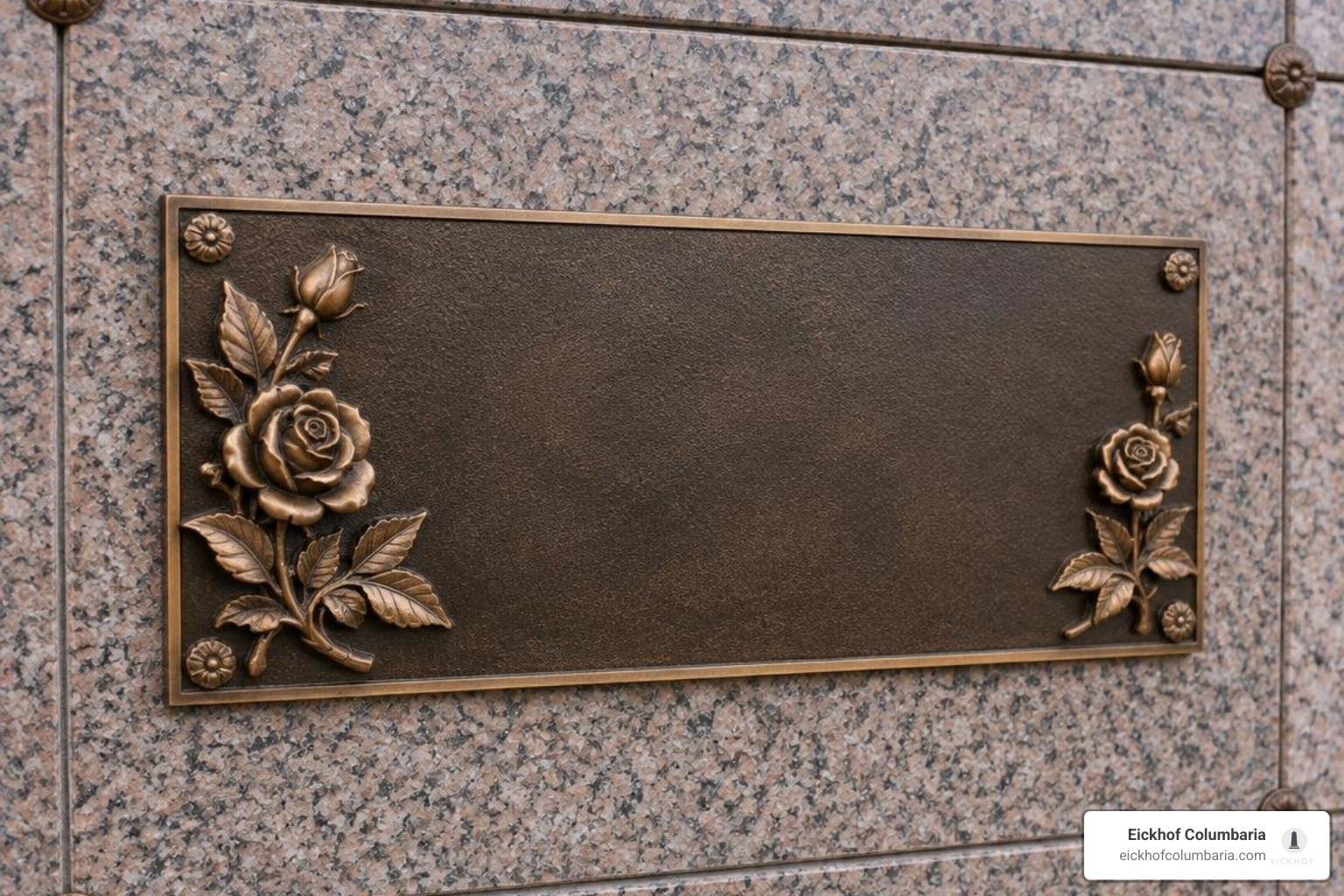
- Exterior Stone Faceplate: Finally, a thick, polished marble or granite faceplate is secured over the front with concealed or ornamental bronze hardware, displaying the memorial inscriptions.
Because these chambers are sheltered from groundwater, oxygen flow is moderated, and temperature swings are buffered, the natural process of desiccation occurs differently than it does underground. To learn more about the physical dynamics at play, read our analysis on resting above ground why bodies mummify instead of decay in a mausoleum.
Primary Types of Mausoleums: Public, Private, and Garden Options
Mausoleums come in diverse architectural styles designed to accommodate different family traditions, community needs, and budget profiles.
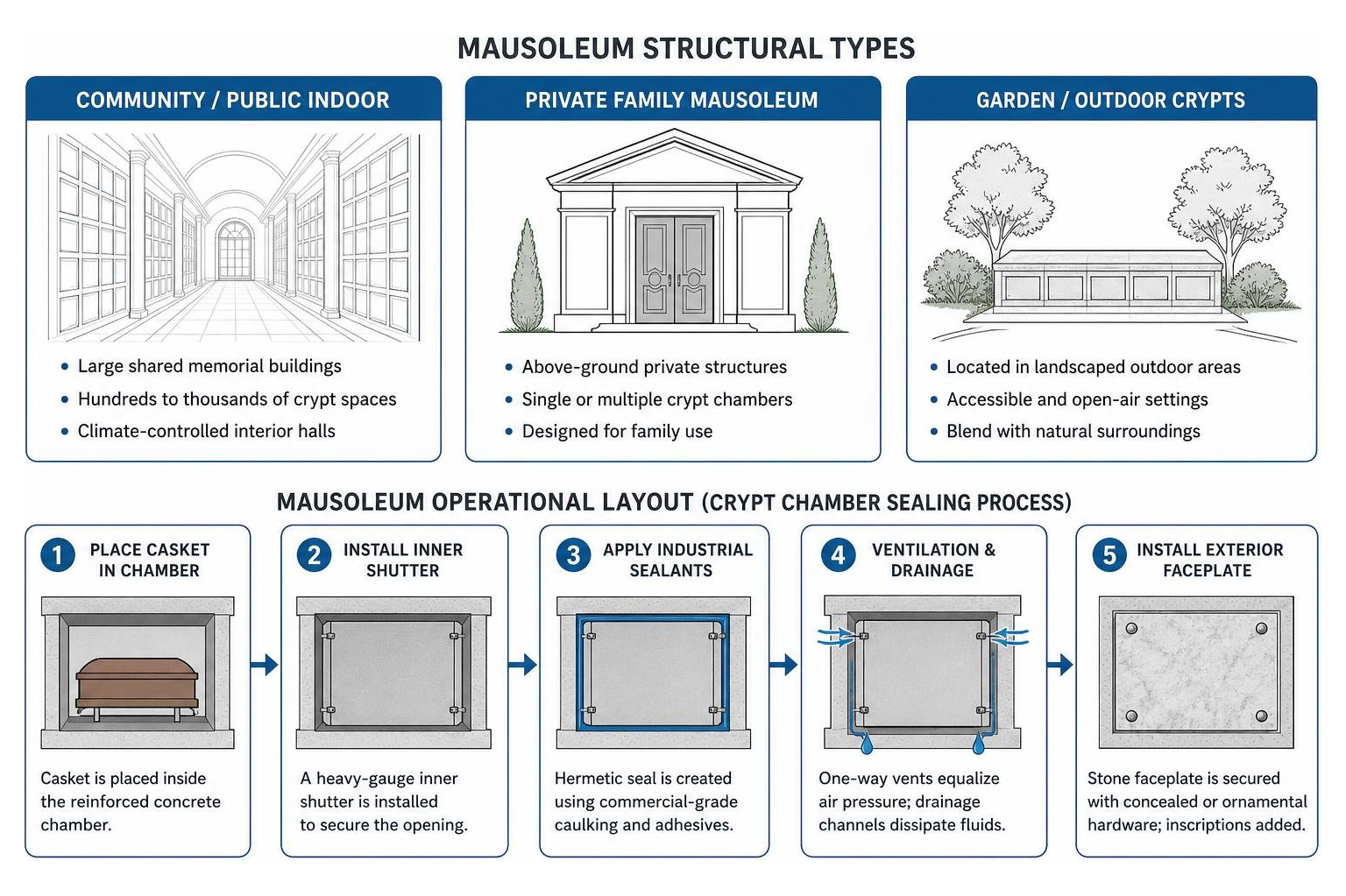
Community and Public Indoor Mausoleums
Community indoor mausoleums are large, shared memorial buildings open to the general public. They house hundreds—or even thousands—of crypt spaces arrayed across long, stately corridors.
These grand facilities typically offer:
- Climate-Controlled Comfort: Heating and air conditioning allow family members to visit loved ones in total comfort, regardless of winter freezes or summer heatwaves.
- Integrated Chapels: Many indoor facilities feature committal chapels with stained glass windows, sound systems, and comfortable seating for memorial services.
- Tiered Pricing: Crypts are stacked vertically (typically 4 to 6 tiers high). The height of the crypt directly influences its price. “Heart-level” or “touch-level” crypts (tiers 2 and 3) are the most sought-after and expensive, whereas “prayer-level” crypts (the lowest tier near the floor) and “heaven-level” crypts (the highest tier near the ceiling) offer substantial savings.
Private Family Mausoleums and Walk-Up Crypts
For families seeking complete seclusion, generational continuity, and tailored architectural expression, private family mausoleums represent the pinnacle of memorial craftsmanship.
A private structure can be designed as a walk-in building—complete with custom bronze entryway doors, stained glass, interior granite benches, and dedicated vestibules—or as a compact, freestanding walk-up structure where individual crypts are accessed from the outside.
Building a bespoke family monument allows you to consolidate generations within a singular, enduring estate. Discover more about above ground burial in a private mausoleum crypt traditions and modern options to explore how families customize these historic structures today.
Garden Mausoleums and Outdoor Crypts
Garden mausoleums provide above-ground entombment in an open-air environment. The crypt fronts open directly to the outdoors, surrounded by landscaped lawns, reflecting pools, and manicured walkways.
Constructed from heavy, weather-resistant granites designed to withstand direct sun, rain, and freezing temperatures, garden mausoleums offer a tranquil open-air visitation experience. Because they do not require enclosed heating, cooling, or massive indoor structural halls, outdoor garden crypts are generally more economical than indoor crypts while retaining all the protective benefits of above-ground entombment.
Advantages and Disadvantages of Mausoleum Entombment
Every memorial option comes with distinct trade-offs. Weighing the benefits against the practical limitations helps ensure you make an informed choice.
Key Benefits: Protection, Visitation, and Land Efficiency
- Clean and Dry Environment: One of the most common reasons people choose a mausoleum is an aversion to being placed underground. Crypts keep caskets isolated from dirt, mud, and water.
- Sheltered, Accessible Visitation: Indoor community mausoleums make visiting comfortable for elderly family members or individuals with mobility challenges, avoiding uneven grass, mud, or extreme weather.
- Consolidation of Family Estates: A single private mausoleum holding 6 to 12 crypts occupies significantly less ground surface area than an equivalent row of traditional in-ground burial plots.
- Ecological Land Use: By stacking crypts vertically, community mausoleums drastically reduce the cemetery footprint required per burial, preserving green space and optimizing urban cemetery acreage.
Potential Drawbacks, Maintenance Needs, and Regulations
- Higher Upfront Investment for Private Builds: Designing, engineering, and fabricating a private family structure involves significant capital compared to standard plot purchases.
- Cemetery Visitation Constraints: Indoor public mausoleums maintain specific opening and closing gate hours, whereas outdoor cemetery plots are often accessible from dawn until dusk.
- Strict Decoration Rules: Cemetery associations enforce rigid guidelines regarding what can be attached to crypt fronts. Adhesives, unauthorized hardware, or excessive floral displays can damage polished stone faceplates. If you plan to add personal memorials, ensure you mount your mausoleum flower vase holder correctly every time according to facility specifications.
Pricing Breakdown and Purchasing Considerations
Understanding the overall financial landscape of above-ground entombment prevents surprises during what is already an emotionally demanding time.
| Resting Place Type | Average Base Cost | Capacity | Key Features & Inclusions |
|---|---|---|---|
| Community Crypt (Single) | $4,000 – $12,000 | 1 Casket | Indoor/outdoor access, shared facility upkeep, tiered pricing |
| Companion Crypt (Double) | $7,000 – $18,000 | 2 Caskets | Side-by-side or end-to-end (tandem) configuration |
| Private Family Mausoleum | $50,000 – $500,000+ | 2 to 12+ Caskets | Bespoke granite, private estate grounds, custom architectural detail |
| Columbarium Niche (Cremation) | $1,000 – $4,500 | 1 to 2 Urns | Compact 12″x12″ footprint, glass or granite front, minimal space use |
Planning for Mausoleum Entombment: Costs and Crypt Selection
When budgeting for a community crypt, the base property purchase is only one part of the financial equation:
- Crypt Purchase Rights: $4,000 to $12,000 for an individual space, depending heavily on indoor vs. outdoor location and the tier level (eye-level vs. top/bottom).
- Companion Formats: $7,000 to $18,000. Companion crypts come either “side-by-side” (sharing a wide faceplate) or “tandem” (where caskets are placed end-to-end lengthwise in a deeper chamber, providing a cost-effective double option).
- Entombment Opening/Closing Fees: The cemetery staff charges a separate service fee of $500 to $1,500 at the time of burial to hoist the casket, install the inner shutter, seal the chamber, and secure the exterior stone.
- Engraving and Personalization: Inscribing names, dates, emblems, or mounting cast bronze plaques typically adds $500 to $2,000.
By comparison, while an in-ground plot might appear cheaper initially ($1,000 to $4,000), subterranean burial mandates purchasing an outer burial vault or concrete grave liner ($1,000 to $3,000), an excavated grave opening/closing fee ($1,000 to $2,500), and a granite headstone with a poured concrete foundation ($1,500 to $5,000). When totaled, the cost of a standard community crypt is often comparable to an in-ground burial.
Cemetery Rules, Foundation Engineering, and Hidden Fees
If you choose to build a freestanding private family mausoleum, additional structural logistics apply:
- Engineering and Foundation Work: Cemeteries require deep, steel-reinforced concrete raft foundations engineered to support tens of thousands of pounds of solid granite.
- Site Logistics and Crane Access: Delivering massive stone sections requires wide cemetery access roads and heavy industrial crane rigs, which must be coordinated directly with cemetery management.
- Perpetual Care Trust Endowments: State regulations and cemetery rules require a percentage of the total structure price (often 10% to 20%) to be paid into an irrevocable perpetual care fund, guaranteeing that the cemetery can maintain the exterior stonework and surrounding grounds indefinitely.
Architectural Heritage and Cremation Alternatives
Above-ground entombment has an illustrious history spanning millennia, evolving from imperial monuments into modern civic and religious architectural options.
Historical Precedents in Monumental Entombment
The word mausoleum originates from the magnificent tomb built in 350 BCE for King Mausolus of Caria at Halicarnassus—one of the Seven Wonders of the Ancient World. Throughout history, monumental above-ground tombs have served as lasting testaments of cultural heritage and architectural ingenuity.
In the United States, early presidential vaults set the standard for classical masonry. George Washington’s Tomb at Mount Vernon was constructed between 1831 and 1837 as a dignified brick vault with marble sarcophagi, fulfilling Washington’s specific will directives after an older family vault deteriorated. Further historical insights are detailed in the George Washington’s Tomb | George Washington’s Mount Vernon archives.
Internationally, state-level entombments have pushed the boundaries of engineering and preservation:
- In Moscow, Lenin’s Mausoleum in Red Square combines concrete, polished red granite, and labradorite resting on vibration-absorbing foundation piles.
- In Brazil, the Neo-Gothic Imperial Mausoleum inside the Cathedral of Saint Peter of Alcantara in Petrópolis serves as the permanent resting place for Emperor Pedro II and the imperial family following historical repatriations from Europe.
- In modern royal design, the Norwegian monarchy collaborated with leading architectural artisans on King Harald V’s sarcophagus at the Royal Mausoleum – Snøhetta, crafting a ship-shaped sarcophagus from carbon-absorbing olivine stone with peridot gemstones and lost-wax cast bronze.
Comparing Mausoleum Entombment to Cremation Columbarium Niches
As cremation rates continue to rise across the country, many families seek above-ground memorialization without the physical bulk or expense of a full-casket crypt. A columbarium is an architectural structure specifically designed with secure compartments, known as niches, sized to house cremation urns (typically 12″ x 12″ x 12″).
At Eickhof Columbaria, we design, manufacture, and install premium columbaria and custom niche walls for cemeteries, churches, and mausoleums across the United States. Utilizing our proprietary handcrafted, concealed-hardware stone systems, we build custom exterior columbaria and interior niche walls that blend seamlessly into existing mausoleum buildings.
Whether featuring polished granite shutters or elegant, climate-controlled glass-front niches that allow families to display personal heirlooms alongside urns, columbarium walls offer the same permanence, dignity, and above-ground elegance as traditional crypts while maximizing spatial efficiency and minimizing family costs.
Frequently Asked Questions About Mausoleums
Is mausoleum burial more expensive than traditional ground burial?
A single crypt in a community mausoleum is often very comparable in total cost to a standard in-ground burial. While the crypt space itself carries a higher upfront ticket price ($4,000 to $12,000) than raw cemetery acreage, it eliminates the mandatory costs of an underground vault liner ($1,000 to $3,000), separate monument foundation fees, and expansive plot excavation. However, bespoke private family mausoleums ($50,000 to $500,000+) are significantly more expensive than standard burial options due to custom masonry, engineering, and private land requirements.
How are caskets sealed and preserved inside a crypt?
Caskets are placed horizontally inside a reinforced concrete chamber. Staff members seal the opening using an inner shutter panel anchored with specialized industrial-grade caulking. This creates a secure barrier that prevents odor transmission and isolates the casket from humidity. The crypt features passive ventilation channels that allow gases and pressure to equalize safely while keeping the exterior corridor clean and dry.
Who is responsible for the perpetual care and maintenance of a mausoleum?
For public and community mausoleums, the cemetery management organization is legally responsible for routine maintenance, climate-control utilities, janitorial care, and roof upkeep. These activities are funded through statutory perpetual care trust funds collected during crypt sales. For private family mausoleums, structural maintenance and specialized repairs remain the responsibility of the family estate, backed by perpetual care agreements established with the cemetery at the time of construction.
Conclusion
Choosing an above-ground resting place is a deeply personal decision that balances legacy, aesthetic beauty, family cohesion, and long-term security. From accessible community garden crypts to grand, bespoke family estates, above-ground entombment provides a clean, sheltered alternative to subterranean burial.
For churches, municipal cemeteries, and private memorial parks looking to expand their above-ground offerings, integrating precision-engineered niche walls provides a timeless and space-efficient solution. At Eickhof Columbaria, our turnkey niche wall systems and concealed-hardware granite engineering empower communities to create dignified, enduring memorial spaces for generations to come.
To evaluate which memorial pathway best aligns with your long-term estate planning or institutional property goals, continue your research by understanding resting places beyond traditional in ground burial.